
herc jobs logo

JOB SEEKER LOGIN HERCONNECT (MEMBER LOGIN)

Menu
  • Job Seeker Resources
    • Search Jobs
    • Create an Account
    • Career Advice
    • Ebooks
    • Virtual Career Fairs
    • Webinars
    • Dual Careers Resources
    • Inclusive Career Hubs
  • Employer Resources
    • Become a Member
    • Products and Rates
    • Post a Job
    • Regional HERCs
    • Toolkits
  • About Us
Menu
  • Job Seeker Resources
    • Search Jobs
    • Create an Account
    • Career Advice
    • Ebooks
    • Virtual Career Fairs
    • Webinars
    • Dual Careers Resources
    • Inclusive Career Hubs
  • Employer Resources
    • Become a Member
    • Products and Rates
    • Post a Job
    • Regional HERCs
    • Toolkits
  • About Us


Archives for June 2021

Use Your LinkedIn Profile to Tell Your Story

June 24, 2021 by Marketing Director

When creating a LinkedIn profile, some people simply copy and paste sections from their resume. Using your resume is a good starting point for your LinkedIn profile, but doing only that doesn’t make use of all the bells and whistles offered by that social media platform.

A resume on its own can be quite flat, with facts and stats about your professional background and experience. With a LinkedIn profile, you have the ability to showcase your work, creativity, and, perhaps most importantly, professional story.
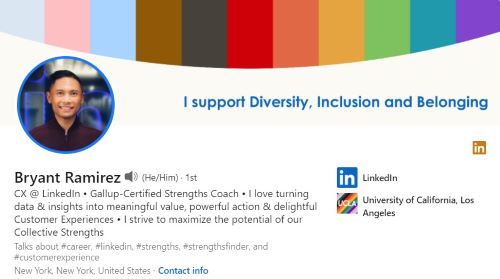
“LinkedIn Rock Your Profile” webinar presenter Bryant Ramirez’s LinkedIn “postcard” (i.e., top portion of a LinkedIn profile)

Focus on these sections of your LinkedIn profile to get noticed by potential employers and your peers.

Profile Photo

A profile photo is a basic element of a LinkedIn profile, but it’s surprising how many people skip uploading one. When people view your profile, being able to see your face shows that you’re a real person, not a fake account. It can also help your connections recognize you, whether you’re trying to add them to your network or if they’re looking for you.

Headline

The second text element of your profile that people will see (the first being your name) is your headline. The default headline on LinkedIn is your most recent job title and company. Since that information appears later in your profile, you should change your headline to communicate something else about you. Your headline could reference aspects of your work that you are most passionate about or your strongest skills or your values/mission statement. Keep it fresh – don’t be afraid to revisit and change your headline every now and then.

Cover Photo

The cover photo is another highly visible part of your LinkedIn profile that many people don’t bother to add. While your profile photo shows who you are, your cover photo is another visual way to demonstrate who you are, what you do, and/or what you’re passionate about. For instance, you could upload a photo of you in action at work, such as giving a lecture, or it could showcase something you produced, like a photo at an event you organized. Instead of a photo, it could be the cover artwork of a report or presentation that you put together.

Experience

Descriptions

In the description sections under “Experience,” it’s easy to stick to the bullet points included in your resume. During the LinkedIn Rock Your Profile webinar hosted by HERC, many participants asked if it was better to use bullet points or prose. Our speaker, Bryant Ramirez, recommended using both, but he emphasized that you can use this space to highlight your story and professional journey.

You can’t tell from those standard resume bulletpoints why someone chose to take that position at that company or what having that position meant to that person. Perhaps it was this person’s dream job since childhood or maybe they had a special connection to the community served by that organization. Share that story as prose, then use bulletpoints to convey your job responsibilities and accomplishments.

Media

Included in the “Experience” part of your LinkedIn profile are places to upload “Media” – work samples or other pieces that illustrate your skills and expertise. Potential employers may not see samples of your work until after your resume reached their radar and you’ve been invited to be interviewed. LinkedIn makes it easy for you to call attention to projects you’ve completed right away. Add media to your profile, whether it’s a report or case study that you wrote or a link to a video or article that you produced or participated in.

Recommendations

References are often requested near the end of the interviewing process and, usually, only final candidates are asked to provide them. If you have some impressive references or you have too many to include on your reference list, ask those connections to post a recommendation on your LinkedIn profile. Their stories about you and your work could make a difference and give a strong first impression to potential employers.


Social media platforms like LinkedIn have changed the way job seekers and employers find and interact with each other. Use their features and tools creatively to stand out and differentiate yourself from other job seekers!

About the Author: Marcia Silva is the director of marketing and communications at the Higher Education Recruitment Consortium. She strives to create engaging, research-informed content that empowers job seekers and employers committed to creating inclusive workplaces. She is passionate about supporting nonprofit organizations in using digital media and technology to encourage participation, build trust, and strengthen communities.

Filed Under: Job Search, Networking Tagged With: Bryant Ramirez, LinkedIn, Marcia Silva

What’s Next? Take Time to Explore Your Career Options

June 7, 2021 by Marketing Director

This article is from the National Postdoctoral Network. Mark your calendars for July 12 & 13! HERC is partnering with the National Postdoctoral Network on its 2021 NPA Gender Equity Summit. The summit will explore issues across the full spectrum of gender, delving into obstacles surrounding gender equality in the postdoctoral community. Over the course of two days, the virtual summit presents a series of interactive, roundtable discussions, meant to further discussions on the importance of gender equity. Registration is free – sign up today!

Career development is an iterative multi-stage process of self-assessment, career exploration, career choice refinement, and finally focused job searching. Career exploration allows you to consider aspects to incorporate into your future career and learn about potential career options to start.

Self-assessment tools take inventory of your skills (things you’re good at), your interests (things you like to do), and your values (job attributes that are important to you) to identify satisfying careers that might be a great fit.

You can also explore by talking to people who are in various careers through informational interviewing and networking, researching different career fields, and trying out careers using a job simulations tool or taking on part-time internships.

Self-Assessment

Self-assessment is important throughout the career process. An initial self-assessment can help you identify and refine your interests, ideal work tasks and environments as well as your work style. Periodic self-assessment can also help guide you in creating your individual development plan and refining your goals as you move through your postdoc.

Some good self-assessment websites oriented toward those with doctoral degrees include myIDP and ImaginePhD. If you are interested in pursuing an academic career, check out the Academic Career Readiness Assessment developed by UCSF.

Informational Interviewing and Networking

Another great strategy is to conduct informational interviews. Informational interviews are informal conversations that help you learn more about what it’s like to work in a particular type of position.

Networking is also a critical part of the career exploration and job search processes. Networking involves creating focused connections within your area of career interests. Networking can serve many purposes, including identifying sources for informational interviews, potential job leads, or potential professional collaborators and mentors. Many people are uncomfortable with the idea of networking, but good networking involves a mutually beneficial connection, and it’s important to remember that you also bring value to the relationship. The Career Center at UC Berkeley has compiled a guide for Informational Interviewing.

Creating and maintaining an up-to-date LinkedIn profile is great way to stay in touch with people you meet. Many recruiters use LinkedIn to search for talent, so having a complete profile is very helpful for the job search.

An important tool during both the networking and interview processes is the elevator pitch. The elevator pitch is a short statement that briefly explains your research and career goals. Developing a succinct and focused statement that can be adapted for different contexts is an art developed with practice. The American Society for Biochemistry and Molecular Biology (ASBMB) has created a short video that discusses tips for elevator pitches, introductions, and etiquette.

Career Paths and Options, Particularly for Postdocs

There are a variety of career options after the completion of your postdoc. Fortunately, there are resources to help you understand and explore these different paths. Some common paths include research, teaching, administration, policy, communication, consulting, and entrepreneurship. The positions can be in all areas of research enterprise including higher education, other non-profit organizations, industry, government agencies or a business you may start yourself.

Excellent tools include:

  • Overview of PhD Career Fields by the University of Chicago myCHOICE Program
  • InterSECT Job Simulations (to try out potential careers)

You have a huge variety of career options available and this may sometimes feel overwhelming. However, it is important to remember that there are many career resources available to help you with the process. Working with others, whether a career specialist, a mentor, or others via social media, are all great ways to stay focused, receive feedback and feel supported through the process.

This content was adapted with permission from the National Postdoctoral Association’s “A Postdoc’s Guide To Career Development” – access the full guide and other career resources at the NPA’s Postdocs Resource Library.

Filed Under: Career Planning, Career Transitions, Higher Education Career Exploration Tagged With: Career Planning, National Postdoctoral Association

Find it Fast

Join HERC
HERConnect (Member Login)
  • Partners
  • About Us
  • Newsroom
  • Contact Us

Regional HERCS

  • Carolinas
  • Greater Chicago Midwest
  • Metro New York & Southern Connecticut
  • Michigan – Ohio – Western Pennsylvania – West Virginia
  • Mid -Atlantic
  • Midwest
  • Mountain West
  • New England
  • New Jersey – Eastern Pennsylvania – Delaware
  • Northern California
  • Northwest
  • Southeast
  • South Midwest
  • Southern California
  • Upstate New York
© 2000 – 2025 The Higher Education Recruitment Consortium is a project of the Tides Center, a 501(c)3 non-profit organization.
Tides’ State Nonprofit Disclosures
Sitemap | Terms | Privacy Policy
Powered by WSI Digital
Cookie settingsAccept Cookies
We use cookies so that we can remember you and understand how you use our site. If you do not agree with our use of cookies, please change the current settings found in our Cookie Policy . Otherwise, you agree to the use of the cookies as they are currently set....
Privacy & Cookies Policy

Privacy Overview

This website uses cookies to improve your experience while you navigate through the website. Out of these cookies, the cookies that are categorized as necessary are stored on your browser as they are essential for the working of basic functionalities of the website. We also use third-party cookies that help us analyze and understand how you use this website. These cookies will be stored in your browser only with your consent. You also have the option to opt-out of these cookies. But opting out of some of these cookies may have an effect on your browsing experience.
Necessary
Always Enabled
Necessary cookies are absolutely essential for the website to function properly. This category only includes cookies that ensures basic functionalities and security features of the website. These cookies do not store any personal information.
Non-necessary
Any cookies that may not be particularly necessary for the website to function and is used specifically to collect user personal data via analytics, ads, other embedded contents are termed as non-necessary cookies. It is mandatory to procure user consent prior to running these cookies on your website.
SAVE & ACCEPT