

herc jobs logo

JOB SEEKER LOGIN HERCONNECT (MEMBER LOGIN)

Menu
  • Job Seeker Resources
    • Search Jobs
    • Create an Account
    • Career Advice
    • Ebooks
    • Virtual Career Fairs
    • Webinars
    • Dual Careers Resources
    • Inclusive Career Hubs
  • Employer Resources
    • Become a Member
    • Products and Rates
    • Post a Job
    • Regional HERCs
    • Toolkits
  • About Us
Menu
  • Job Seeker Resources
    • Search Jobs
    • Create an Account
    • Career Advice
    • Ebooks
    • Virtual Career Fairs
    • Webinars
    • Dual Careers Resources
    • Inclusive Career Hubs
  • Employer Resources
    • Become a Member
    • Products and Rates
    • Post a Job
    • Regional HERCs
    • Toolkits
  • About Us


Archives for September 2021

What Higher Ed Job Seekers Want Now

September 7, 2021 by Marketing Director

Continued concerns about workplace health and safety, combined with challenges in finding candidates for job openings, have put pressure on higher education employers to address the changing needs and expectations of job seekers and current staff and faculty.

Earlier this year, HERC conducted its annual job seeker survey to understand their experience looking for work in higher education and to identify how HERC can best support them during the process of finding, landing, and keeping their ideal position. This year’s survey included additional questions about the impact of COVID-19 and the increasing importance of diversity, equity, and inclusion in work policies.

Given today’s volatile job market, we thought it was important for job seekers to know that many share the same priorities and values when it comes to their careers in higher education. We learned that job seekers are looking for employers that support career advancement, a healthy work-life balance, and diversity, equity, and inclusion (DEI) in the workplace.

Who Responded

The survey had 2,722 respondents, who reported these demographics:

  • 67% hold master’s degrees or higher
  • 40% are people of color
  • 12% are individuals with disabilities
  • 67% are women; 28% are men
  • 1% are ages 18 to 21; 34% are 22 to 37; 37% are 38 to 53; and 27% are over 53

46% of survey respondents reported being staff and 56% indicated they are faculty. Some individuals reported being both staff and faculty.

Job Searching Now
Infographic: TOP REASONS: If you are searching for a new job, why? (Select top 3 reasons)

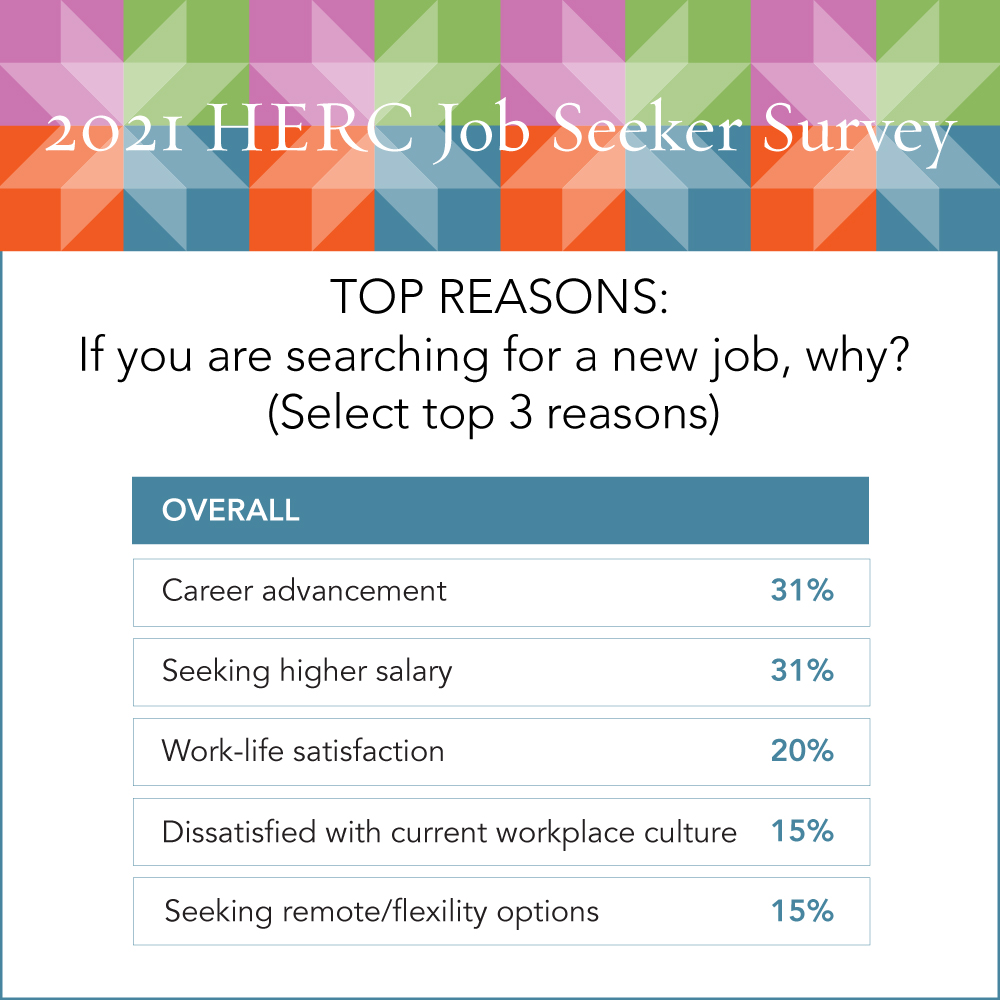
Of those reporting that they were searching for a new job, the top reasons for doing so were career advancement (31%), seeking higher salary (31%), work-life satisfaction (20%), dissatisfied with current workplace culture (15%), and seeking remote/flexibility options (15%). Higher education staff and faculty reported the same top three reasons, but with differing prioritization.

Job Advancement
Infographic: Do you expect to advance in your career at your current institution or with a new employer? 11% - Current institution, 56% - New Institution, 33% - Unsure

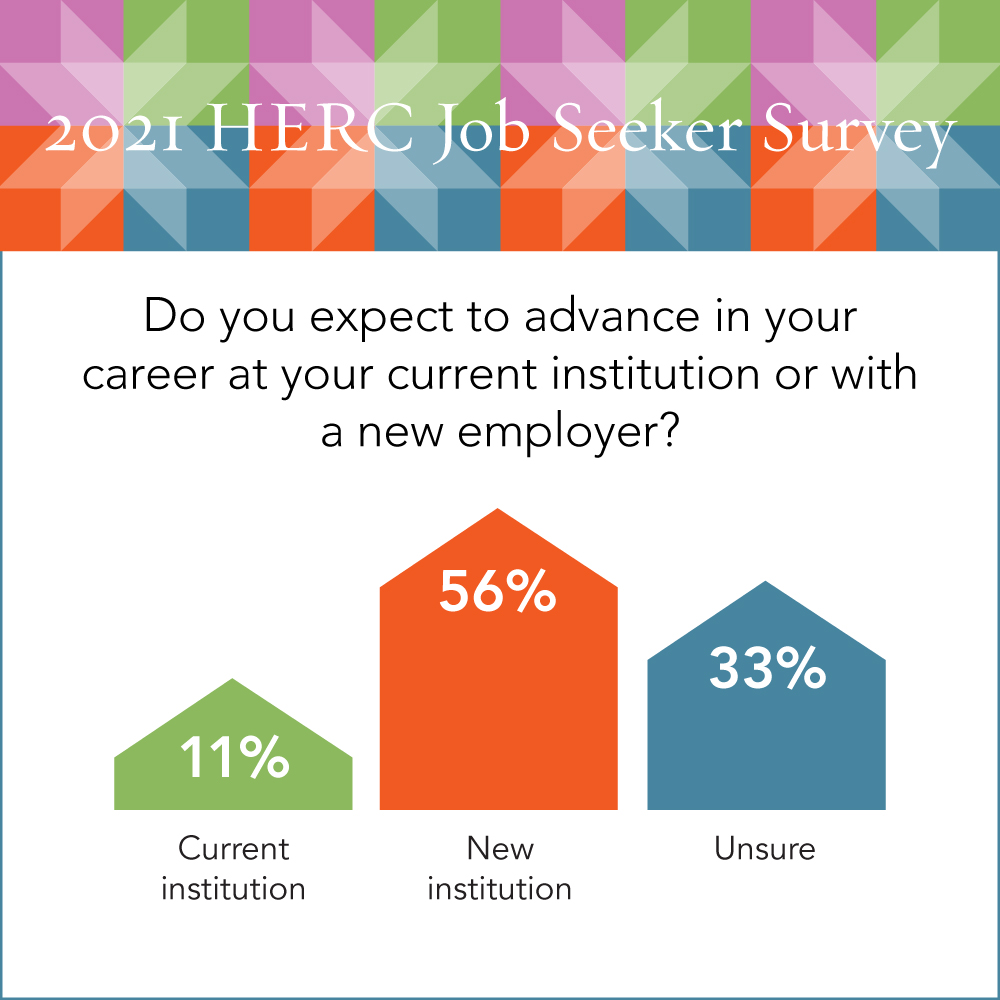
When asked where job seekers expected to advance in their careers, more than half of survey respondents reported at a new institution (56%) and the next largest group of respondents were unsure (33%).  This result indicates that most survey respondents were not interested in or did not see opportunities for internal growth and promotion within their current institutions.

Expectations
Infographi: As it relates to your career and the COVID-19 pandemic, please rate hwo well each statement describes you and yoru experience with your higher education institution.

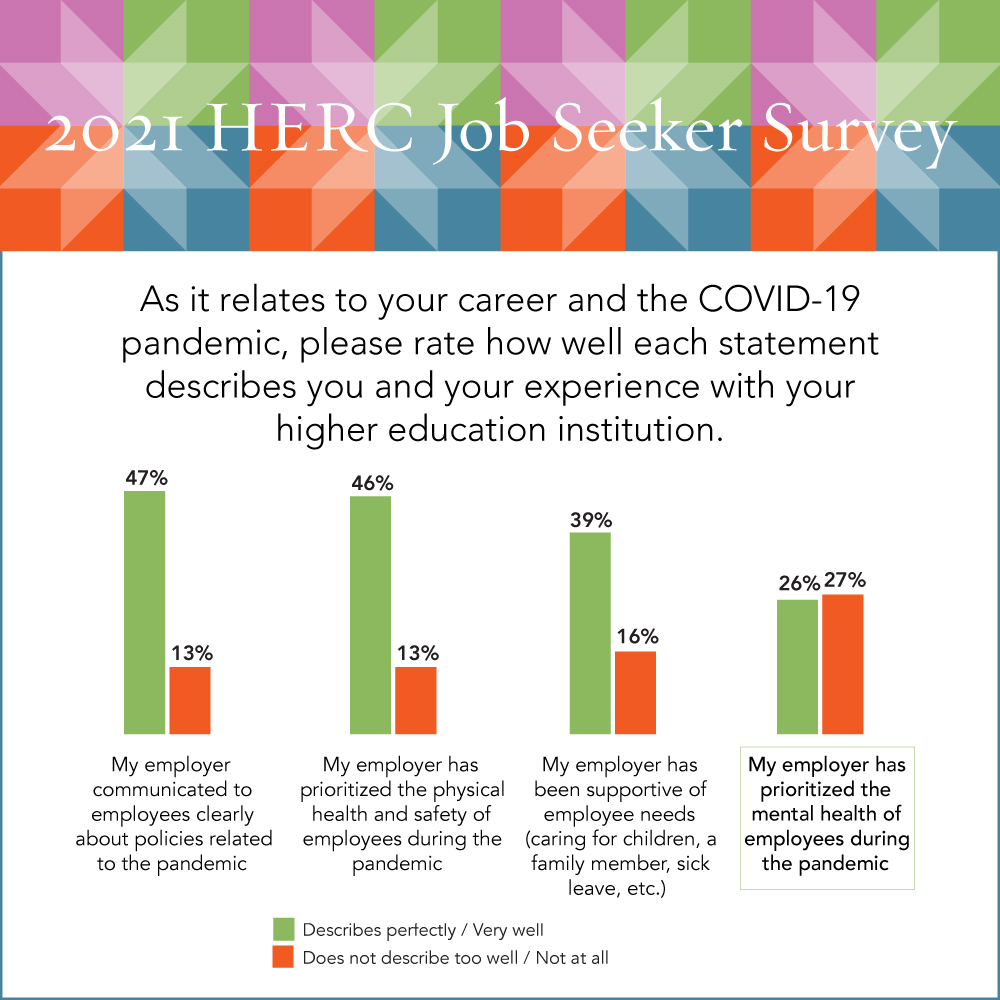
Job seekers reported strong confidence in some of the support provided by employers as it relates to their careers and the COVID-19 pandemic. Job seekers’ confidence fell when rating their employer’s support of employee needs and dipped even more when considering their employer’s prioritization of employees’ mental health.

Learning about what job seekers need and want is crucial to our member institutions who are committed to advancing diversity, equity, and inclusion in the higher education workforce. We encourage you to participate in our annual job seeker survey (our next one will be conducted in early 2022) and our monthly quick poll on LinkedIn (follow HERC on LinkedIn).

Filed Under: Job Seeker Survey

Higher Ed Job Seekers Want Career Advancement, Work-Life Satisfaction, and DEI Policies and Practices

September 7, 2021 by Marketing Director

New Report on Changing Attitudes and Expectations about Higher Education Careers

SAN FRANCISCO, CA – Continued concerns about workplace health and safety, combined with challenges in finding candidates for job openings, have put pressure on higher education employers to address the changing needs and expectations of job seekers and current staff and faculty. A new report from the Higher Education Recruitment Consortium (HERC) shares highlights from its annual survey of job seekers to understand their job search experience and to identify how employers can best support them during the process of finding, landing, and keeping their ideal position.  [The full report is available to HERC members. If you are interested in accessing the report, please contact Marcia Silva – see info at the bottom.]

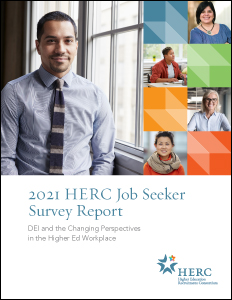
The new publication, “2021 HERC Job Seeker Survey Report: DEI and the Changing Perspectives in the Higher Ed Workplace,” provides data-informed considerations for HR, academic affairs, and diversity leaders in developing inclusive and equitable recruitment and retention policies.

“This report includes timely information for higher education institutions as they recruit and retain faculty and staff,” said Derek Smith, HERC Executive Director. “Now more than ever, job seekers are looking closely at an institution’s demonstrated commitment to programs and policies that support professional growth, work-life satisfaction, and diversity.”

The report addresses four topics: job searching now, job advancement, expectations of employers, and diversity, equity, and inclusion. Many of the shifts in thoughts and expectations in these areas are driving workforce policy changes and will have long-term impacts on what attracts and keeps staff and faculty at higher education institutions.

Of survey respondents reporting that they were searching for a new job, the top reasons for doing so were career advancement (31%), seeking higher salary (31%), and work-life satisfaction (20%). Higher education staff and faculty reported the same top three reasons, but with differing prioritization.

When asked where they expected to advance in their careers, more than half of survey respondents reported at a new institution (56%) and the next largest group of respondents were unsure (33%). This result indicates that most survey respondents were not interested in or did not see opportunities for internal growth and promotion within their current institutions.

Survey respondents reported confidence in some of the support provided by employers during the COVID-19 pandemic, such as clear communications about policies related to the pandemic and prioritization of employees’ physical health and safety. Confidence fell when rating their employer’s support of employee needs and dipped even more when considering their employer’s prioritization of employees’ mental health.

The increased attention on diversity, equity, and inclusion in workforce policies was reflected by our survey respondents: 85% of Non-White and 81% of White survey respondents noted that an employer’s diversity and inclusion policies and practices were very and somewhat important to them.

“HERC members are at the forefront of building diverse and inclusive workplaces in higher education,” said Ruth Molina, HERC Governance Board Chair. “Learning about what prospective job candidates need and want is crucial to our members, especially now as they develop and implement return-to-campus policies.”

ABOUT THE HIGHER EDUCATION RECRUITMENT CONSORTIUM: The Higher Education Recruitment Consortium (HERC) is a nonprofit consortium committed to advancing diversity, equity, and inclusion in the higher education workforce. With over 700 colleges, universities, hospitals, research labs, government agencies, and related organizations, HERC works to ensure member institutions are sites of belonging, where all faculty and staff can thrive. HERC provides resources, networking, and outreach programs to attract, hire, and retain a diverse and qualified workforce.

CONTACT: Marcia Silva, Higher Education Recruitment Consortium, marcia@hercjobs.org, 650-417-3193

Filed Under: News

3 Strategies to Advance Your Career

September 1, 2021 by Marketing Director

Earlier this summer, the National Postdoctoral Association (NPA) hosted a Gender Equity Summit. A session titled “Skills, Strategies, and Lessons on Postdoc Career Advancement” was led by HERC’s own Training and Development Director, Jessica Wise, and featured three speakers. The goals of the session, as described by Wise, were for each attendee to think strategically about their spheres of influence and plan what their careers are going to look like, at the individual, community, and institutional levels.

Here are three strategies to help you advance your career:

1. Claim a professional identity

The first guest speaker was Camille Johnson, Ph.D., the Associate Dean for Research and Faculty Success in the College of Social Science at San Jose State University. Johnson had three goals for the audience: to name their contribution and professional identity, to claim their professional identity within an institution, and to use their personal narrative to guide decisions.

Johnson encouraged attendees to claim their expertise early on with the simple phrase “Hi, my name is _____; I am an expert in _______.” She also asked attendees to identify ways that they want new colleagues or a hiring panel to describe them, which is a way of claiming how you want to be perceived, i.e., “I’m the one who is/who does _______.”

Johnson explained that once an identity has been established (I am an expert in _____, and I am the one who does _______, ________, and _______), then it could be used to guide academic activities and behaviors. Being guided by a professional identity also increases the resolution of activities or opportunities that should be avoided. In other words, if you know what you want to be, then you have a better idea of what not to do and when it is better to say “no”. Postdocs must value themselves and learn to prioritize because time and effort are zero-sum.

2. Networks require intentional cultivation

The second speaker was Claire Horner-Devine, Ph.D., the founder of Counterspace Consulting, LLC. The goals of her session were for attendees to name the role of community in their careers, develop their own growth network maps, and commit to one action to get what they want and need to thrive.

Horner-Devine emphasized that communities are important for personal and professional growth, but there are three key attributes of a successful network. According to Horner-Devine, each person’s network should be you-centered, needs-based, and requires self-agency. She encouraged postdocs to first identify what was missing that they needed (e.g., honest feedback, role modeling, professional development). The next step was to identify who (or what) would fulfill that need and how they would do so. While the strategy behind building this network is similar to that suggested for defining and identifying mentors, not all members of your network need to be mentors! Instead, there may also be peers, coaches, family, friends, training programs, or workshops.

3. Know what you need and what you can compromise on

The third and final speaker was Alicia Simon, the Dual Career Coordinator in the Office of the Provost at the University of Michigan (UM). Dual career couples, those where both partners are academics, face a difficult path to dual employment at a university. In 2018 and 2019 at UM, there were three dual career coordinators handling 242 cases with an average length of 11 months.

While universities want to hire and retain outstanding faculty (especially the opportunity to bring two exciting and talented individuals in a dual career couple), some departments are being asked to consider a dual career candidate they haven’t planned for and may not match their strategic goals. It’s important, then, that the dual career couple has a plan from the start.

The dual career couple should do their homework on each institution and understand the support and resources available. Simon emphasized that the levels of support and resources vary by institution, as do the faculty and/or staff that facilitate dual career support. To make the most of a dual career search, the couple should identify three things that they expect from an institution as well as three things that they are willing to compromise on. Remember to consider both work and life in the community.

Simon says that when the faculty partner (the partner who already has a relationship with an institution) applies for an appointment, the dual career partner should be preparing their application materials for the institution. The faculty partner should ask the search chair or department chair for dual career support as soon as they are comfortable.

Additional resources on dual careers are available from HERC and the University of Michigan.

Each session of the NPA Gender Equity Summit was recorded and is available to watch for free.

About the Author:  Dr. Ada Hagan is a microbiologist with a passion for making science accessible. In 2019, Dr. Hagan founded Alliance SciComm & Consulting, LLC as a means to use her strong background in communications and higher education to help make scientific concepts more easily understood and make the academy more inclusive to future scientists from all backgrounds. Her writing and research have been featured by BBC Radio 4, Science Careers, The Scientist, Massive Science, and the American Society for Microbiology.

Filed Under: Career Advice, Career Planning, Networking, Women Tagged With: Ada Hagan, National Postdoctoral Association

Find it Fast

Join HERC
HERConnect (Member Login)
  • Partners
  • About Us
  • Newsroom
  • Contact Us

Regional HERCS

  • Carolinas
  • Greater Chicago Midwest
  • Metro New York & Southern Connecticut
  • Michigan – Ohio – Western Pennsylvania – West Virginia
  • Mid -Atlantic
  • Midwest
  • Mountain West
  • New England
  • New Jersey – Eastern Pennsylvania – Delaware
  • Northern California
  • Northwest
  • Southeast
  • South Midwest
  • Southern California
  • Upstate New York
© 2000 – 2025 The Higher Education Recruitment Consortium is a project of the Tides Center, a 501(c)3 non-profit organization.
Tides’ State Nonprofit Disclosures
Sitemap | Terms | Privacy Policy
Powered by WSI Digital
Cookie settingsAccept Cookies
We use cookies so that we can remember you and understand how you use our site. If you do not agree with our use of cookies, please change the current settings found in our Cookie Policy . Otherwise, you agree to the use of the cookies as they are currently set....
Privacy & Cookies Policy

Privacy Overview

This website uses cookies to improve your experience while you navigate through the website. Out of these cookies, the cookies that are categorized as necessary are stored on your browser as they are essential for the working of basic functionalities of the website. We also use third-party cookies that help us analyze and understand how you use this website. These cookies will be stored in your browser only with your consent. You also have the option to opt-out of these cookies. But opting out of some of these cookies may have an effect on your browsing experience.
Necessary
Always Enabled
Necessary cookies are absolutely essential for the website to function properly. This category only includes cookies that ensures basic functionalities and security features of the website. These cookies do not store any personal information.
Non-necessary
Any cookies that may not be particularly necessary for the website to function and is used specifically to collect user personal data via analytics, ads, other embedded contents are termed as non-necessary cookies. It is mandatory to procure user consent prior to running these cookies on your website.
SAVE & ACCEPT