

herc jobs logo

JOB SEEKER LOGIN HERCONNECT (MEMBER LOGIN)

Menu
  • Job Seeker Resources
    • Search Jobs
    • Create an Account
    • Career Advice
    • Ebooks
    • Virtual Career Fairs
    • Webinars
    • Dual Careers Resources
    • Inclusive Career Hubs
  • Employer Resources
    • Become a Member
    • Products and Rates
    • Post a Job
    • Regional HERCs
    • Toolkits
  • About Us
Menu
  • Job Seeker Resources
    • Search Jobs
    • Create an Account
    • Career Advice
    • Ebooks
    • Virtual Career Fairs
    • Webinars
    • Dual Careers Resources
    • Inclusive Career Hubs
  • Employer Resources
    • Become a Member
    • Products and Rates
    • Post a Job
    • Regional HERCs
    • Toolkits
  • About Us


Archives for June 2022

So That’s What You Want (2022 HERC Job Seeker Survey Results)

June 15, 2022 by Marketing Director

Higher ed professional at work desk, smiling

Are job seekers in higher education currently searching for a new job? What would keep employees from leaving their current jobs? Earlier this year, you might have participated in HERC’s annual job seeker survey that aims to understand the experiences of those looking for work in higher education and help higher education employers identify ways they can find and keep staff and faculty.

As employers continue to grapple with the “Great Resignation,” they are faced with filling job vacancies and addressing quickly evolving employee needs. Based on the results of our 2022 HERC Job Seeker Survey, we developed recommendations to help colleges and universities create inclusive and equitable recruitment and retention policies.

Below, we highlight some of our survey findings and takeaways.

Who Responded

The survey had 2,061 respondents, who reported these demographics:

  • 79% hold master’s degrees or higher
  • 39% are people of color
  • 17% are individuals with disabilities
  • 3% are veterans
  • 68% identified as women; 28% identified as men; 2% identified as third-gender or non-binary
  • 1% are ages 18 to 21; 34% are 22 to 37; 37% are 38 to 53; and 29% are over 53

58% of survey respondents reported being staff and 31% indicated they are faculty. Some individuals reported being both staff and faculty.

Who’s Looking for New Opportunities
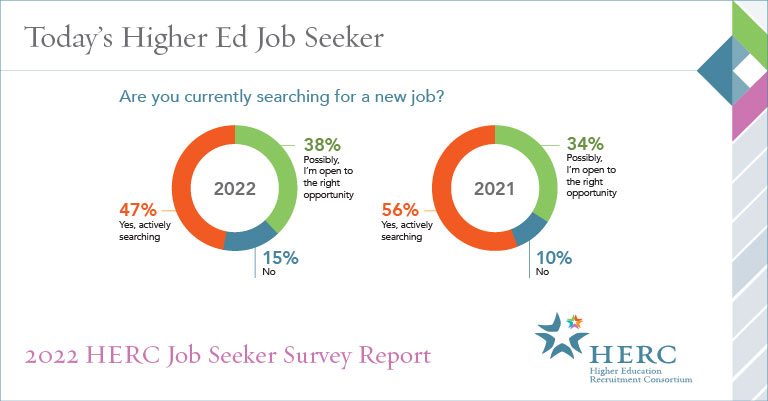
Chart from 2022 HERC Job Seeker Survey Report: Are you currently searching for a new job?

Compared to last year, fewer respondents are actively looking for a new job (56% in 2021 vs. 47% in 2022). With more people refraining from seeking new opportunities, employers should consider shifting some resources to employee retention and raising brand awareness among passive job seekers. Of the 85% of survey respondents that noted they were actively or passively job searching, more than half were not exclusively seeking opportunities in higher education.

What Keeps Employees from Leaving
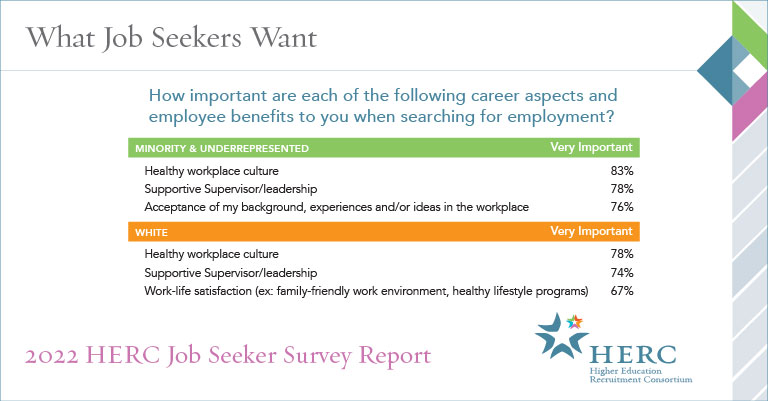
Chart from 2022 HERC Job Seeker Survey Report: How important are each of the following career aspects and employee benefits to you when searching for employment?

Focusing on a healthy workplace with supportive leadership is key to keeping employees: Healthy workplace culture and supportive leadership were rated as the top two career aspects for both minority & underrepresented and white respondents. For minority & underrepresented job seekers, “acceptance of my background” was rated third, while “work-life satisfaction” was third for white respondents.

Diversity, Equity, and Inclusion (DEI) Matters
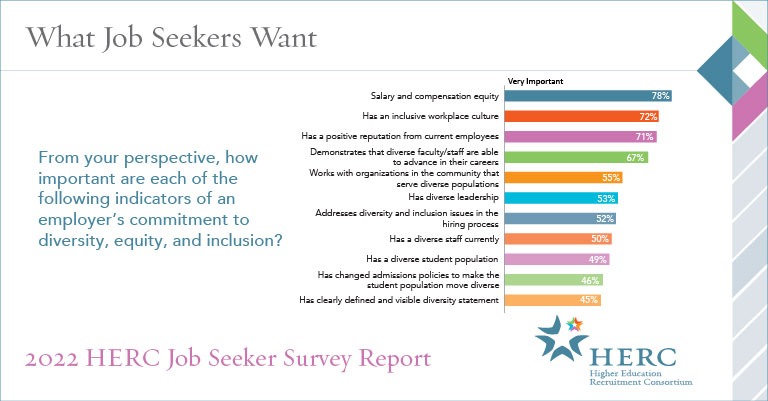
Chart from 2022 HERC Job Seeker Survey Report: From your perspective, how important are each of the following indicators of an employer's commitment to diversity, equity, and inclusion?

Diversity and inclusion policies are “somewhat” to “very” important to the majority (81%) of respondents. Demonstrated commitment to diversity, equity, and inclusion in the workplace is important to job seekers. Concrete evidence including salary equity (78%), inclusive workplace culture (72%), and a positive reputation from employees (71%) are the most important DEI factors.

We want to hear from you! Understanding what job seekers need and want is important to our mission to advance diversity, equity, and inclusion in the higher education workforce. Please participate in our monthly quick polls on LinkedIn (follow HERC on LinkedIn) and our annual job seeker survey (the next one will be in early 2023).

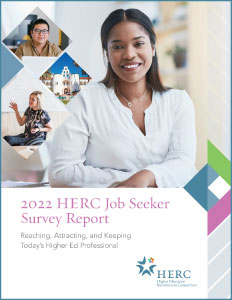
JOIN HERC > Do you work at a higher ed institution that’s striving to diversify its workforce and create an inclusive workplace? Our new publication, “2022 HERC Job Seeker Survey Report: Reaching, Attracting, and Keeping Today’s Higher Ed Professional,” is available to HERC members. Learn more about how HERC supports its member institutions in recruiting and retaining talented and diverse employees.

Filed Under: Job Seeker Survey

Today’s Diverse Higher Ed Job Seekers Value Healthy Workplace Culture, DEI Policies; Open to Careers in Other Industries

June 15, 2022 by Marketing Director

SAN FRANCISCO, CA – As employers continue to grapple with the “Great Resignation,” they are faced with filling job vacancies and addressing quickly evolving employee needs. A new report from the Higher Education Recruitment Consortium (HERC) sheds light on today’s higher education job seekers. [The full report is available to HERC members. If you are media interested in accessing the report, please contact Marcia Silva – see info at the bottom.]

The new publication, “2022 HERC Job Seeker Survey Report: Reaching, Attracting, and Keeping Today’s Higher Ed Professional,” shares key takeaways and recommendations for HR, academic affairs, and diversity leaders in developing inclusive and equitable recruitment and retention policies.

“In a job seeker’s market, it’s essential for higher education institutions to understand today’s job seekers so they can evolve their programs and policies to support an inclusive workplace,” said Jessica Wise, HERC Training and Development Director. “This report provides timely information on what job seekers need and value, such as a healthy workplace culture and acceptance of diverse backgrounds and ideas.”

The report delves into how to grow the job candidate pool, appeal to job seekers, and retain employees. Some of the trends identified in our report from last year remain, such as job seekers finding remote jobs attractive, but new data has emerged that could help reshape how higher education institutions conduct their recruitment activities and communicate their offerings right away.

Some highlighted report findings include:

  • Of the 85% of survey respondents that noted they were actively or passively job searching, more than half were not exclusively seeking opportunities in higher education. Another revealing datapoint is that half of all survey respondents reported that they have not worked or are not currently working in higher education.
  • While 74% of survey respondents would “definitely” or “probably” choose a remote job over in-person, there’s also a strong willingness to relocate for the right opportunity across all age groups: 18-37-year-olds are the most likely to say yes to relocating (46%), followed by 38-53-year-olds (42%) then 54+-year-olds (37%).
  • When asked to rate various career aspects and employee benefits, a healthy workplace culture and supportive leadership were top-rated by both minority & underrepresented and white respondents. However, “acceptance of my background” was rated third for minority and underrepresented job seekers, while “work-life satisfaction” was third for white respondents.
  • The majority of respondents (81%) noted that diversity and inclusion policies were important to them. Concrete evidence of salary equity (78%), inclusive workplace culture (72%), and a positive reputation from employees (71%) were rated by respondents as the most important indicators of an employer’s commitment to diversity and inclusion.

“HERC members know that educating people of all backgrounds, beliefs, and cultures takes a diverse academic workforce,” said Ruth Molina, HERC Governance Board Chair. “Our members value our direct job seeker engagement, which gives us access to a wide range of perspectives from prospective and current higher education professionals.”

ABOUT THE HIGHER EDUCATION RECRUITMENT CONSORTIUM: The Higher Education Recruitment Consortium (HERC) is a nonprofit consortium committed to advancing diversity, equity, and inclusion in the higher education workforce. With over 700 colleges, universities, hospitals, research labs, government agencies, and related organizations, HERC works to ensure member institutions are sites of belonging, where all faculty and staff can thrive. HERC provides resources, networking, and outreach programs to attract, hire, and retain a diverse and qualified workforce.

CONTACT: Marcia Silva, Higher Education Recruitment Consortium, marcia@hercjobs.org, 650-417-3193

Filed Under: News

Tips for Feeling Connected When Working Remotely

June 2, 2022 by Marketing Director

Professional working from home, connected to remote team via video conference call

In the wake of the Covid pandemic, many employers continue to offer remote and hybrid work arrangements. We’re also learning that job seekers really want remote and flexible work to be permanent options, so employers must consider these as potential employee offerings for the foreseeable future.

While remote and flexible work have many benefits, setting boundaries and still feeling connected to colleagues are valid concerns. What can you do to ensure that you are putting the right foot forward in your career when working in a remote or hybrid environment? Here are some tips:

Be clear about your availability.

Keep your teammates informed of your work needs and any issues that may come up for you. Let people know when you are available through shared office calendaring apps and systems and keep people posted on any changes. It’s also important to establish boundaries around personal obligations, and evenings and weekends, when possible.

Connect with your teammates informally.

Without constant proximity of physical offices and chance meetings, it can be hard to maintain a personal connection with teammates or people who may not be currently staffed on a project with you. Build time into your meetings or connect in informal chat groups on platforms like Slack to learn about your coworkers and what they are doing when not working.

Find out preferred communication platforms.

While you may not be able to accommodate everyone’s needs, it is helpful to have a sense of communication preferences, especially as they relate to goals and tasks like brainstorming or sharing feedback. As a consultant working with different clients remotely, I connect with them via platforms like Slack, as well as over email, Zoom, or phone.

Be there when you say you’ll be there.

Be present during hours when your employer expects you to be available. If something comes up at the last minute, communicate that to your team. Also, if you know you are most productive outside of regular work hours, talk with your employer about that.

Create a good routine.

On your work-at-home days, while it may be possible to work for 8 hours or more at a time, over the long term, it is not the best approach for health and even productivity. Extended work patterns without breaks can lead to burnout and other health issues. Build breaks into your day. Take walks. Stretch. Remember, you don’t HAVE to eat at your desk.

Schedule one-on-one meetings.

Touch base regularly with colleagues, supervisors, and/or direct reports to ensure that you are on the same page on shared projects. Also, one-on-ones provide a measure of intimacy that can create some space for communication that group meetings can lack.

Roll with the remote connectivity punches.

Connection issues with Zoom or other platforms are always a possibility when working remotely. Be knowledgeable and comfortable with moving over to another platform, like Google Meet, or even jumping on your cellphone.

Check out more Top Articles on HERC Jobs.

About the Author: Shirley Huey, J.D., is a consultant providing research, writing, and strategic development assistance to organizational clients. Her experience includes service on academic and professional hiring, diversity, and professional development committees as well as coaching peers and mentees. She is also a freelance writer, with a focus on her passions: food and culture.

Filed Under: Remote Work, Resilience, Top Articles, Work/Life Balance Tagged With: Shirley Huey

Find it Fast

Join HERC
HERConnect (Member Login)
  • Partners
  • About Us
  • Newsroom
  • Contact Us

Regional HERCS

  • Carolinas
  • Greater Chicago Midwest
  • Metro New York & Southern Connecticut
  • Michigan – Ohio – Western Pennsylvania – West Virginia
  • Mid -Atlantic
  • Midwest
  • Mountain West
  • New England
  • New Jersey – Eastern Pennsylvania – Delaware
  • Northern California
  • Northwest
  • Southeast
  • South Midwest
  • Southern California
  • Upstate New York
© 2000 – 2025 The Higher Education Recruitment Consortium is a project of the Tides Center, a 501(c)3 non-profit organization.
Tides’ State Nonprofit Disclosures
Sitemap | Terms | Privacy Policy
Powered by WSI Digital
Cookie settingsAccept Cookies
We use cookies so that we can remember you and understand how you use our site. If you do not agree with our use of cookies, please change the current settings found in our Cookie Policy . Otherwise, you agree to the use of the cookies as they are currently set....
Privacy & Cookies Policy

Privacy Overview

This website uses cookies to improve your experience while you navigate through the website. Out of these cookies, the cookies that are categorized as necessary are stored on your browser as they are essential for the working of basic functionalities of the website. We also use third-party cookies that help us analyze and understand how you use this website. These cookies will be stored in your browser only with your consent. You also have the option to opt-out of these cookies. But opting out of some of these cookies may have an effect on your browsing experience.
Necessary
Always Enabled
Necessary cookies are absolutely essential for the website to function properly. This category only includes cookies that ensures basic functionalities and security features of the website. These cookies do not store any personal information.
Non-necessary
Any cookies that may not be particularly necessary for the website to function and is used specifically to collect user personal data via analytics, ads, other embedded contents are termed as non-necessary cookies. It is mandatory to procure user consent prior to running these cookies on your website.
SAVE & ACCEPT