
herc jobs logo

JOB SEEKER LOGIN HERCONNECT (MEMBER LOGIN)

Menu
  • Job Seeker Resources
    • Search Jobs
    • Create an Account
    • Career Advice
    • Ebooks
    • Virtual Career Fairs
    • Webinars
    • Dual Careers Resources
    • Inclusive Career Hubs
  • Employer Resources
    • Become a Member
    • Products and Rates
    • Post a Job
    • Regional HERCs
    • Toolkits
  • About Us
Menu
  • Job Seeker Resources
    • Search Jobs
    • Create an Account
    • Career Advice
    • Ebooks
    • Virtual Career Fairs
    • Webinars
    • Dual Careers Resources
    • Inclusive Career Hubs
  • Employer Resources
    • Become a Member
    • Products and Rates
    • Post a Job
    • Regional HERCs
    • Toolkits
  • About Us


Archives for July 2024

2024 Survey Results: Changing Preferences of Job Seekers

July 23, 2024 by Marketing Director

There was a lot of media attention on higher education leadership and on-campus activities this year. Has this impacted the appeal of working in higher education? Do job seekers feel connected and valued at their current workplaces? What would tempt them to look for a new job? Does diversity and inclusion still matter to them?

Our annual job seeker survey aims to gain insight from current and potential employees in higher education and identify practical and effective strategies employers can use to find, select, and keep staff and faculty.

As higher employers face an aging workforce and competition from non-higher ed sectors for job candidates, they are continually working to meet the needs and expectations of job seekers today.  Based on the results of our 2024 HERC Job Seeker Survey, we published a report with insights and recommendations for HR, academic affairs, and diversity leaders, encouraging them to pay attention to what job seekers across different stages in their careers want, including pathways for career advancement, flexible and remote work, and an inclusive, thriving workplace culture.

Below, we highlight some of our survey findings and takeaways.

Who Responded

The survey had 1,434 respondents, who reported these demographics:

  • 78% hold master’s degrees or higher
  • 42% are people of color
  • 19% are individuals with disabilities
  • 6% are veterans
  • 69% are women; 30% are men
  • 15% are 22-32 years old, 28% 33-43, 26% 44-54, 25% 55-65, 6% 66-76
  • 56% are staff/administrators, 25% faculty members, 9% are graduate students/postdocs, 11% are currently working as both staff/administrators and faculty members

Most job seekers do not feel connected and valued at work
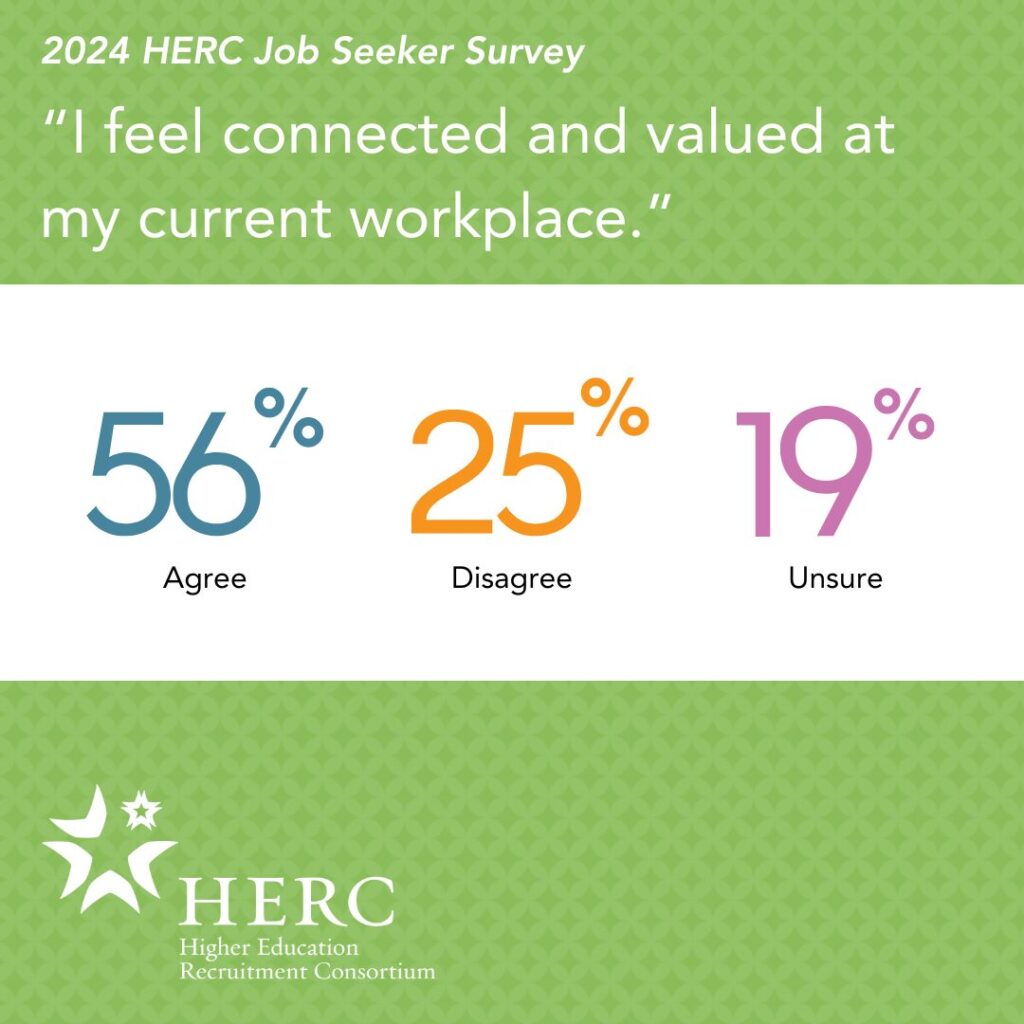
We asked job seekers if they agree or disagreed with this statement: “I feel connected and valued at my current workplace.” More than half of respondents (56%) agreed with the statement, while 25% disagreed and 19% were unsure.

The higher education workforce can be tempted to look for another job
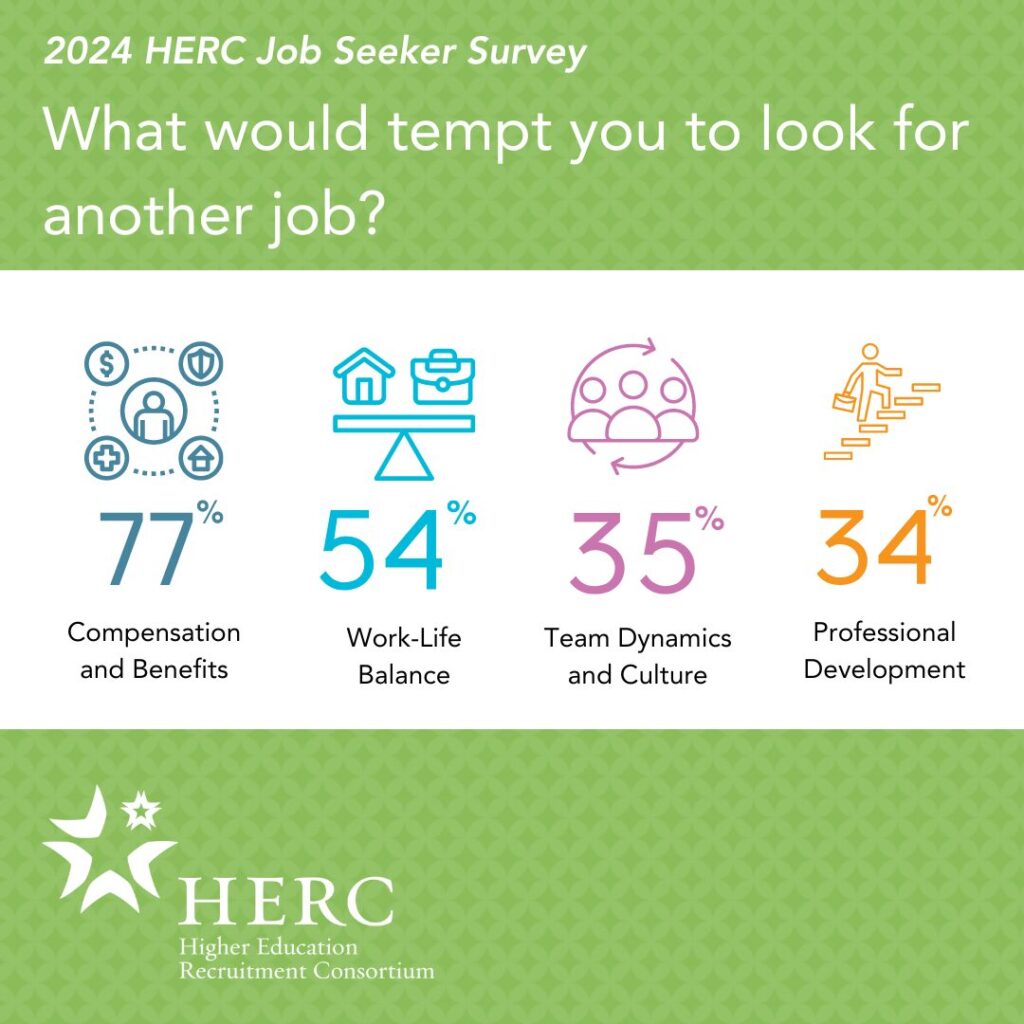
When what would tempt them to look for another job, the top four answers were compensation and benefits (77%), work-life balance (54%), team dynamics and culture (35%), and professional development (34%).

Job seekers are open to opportunities across industries
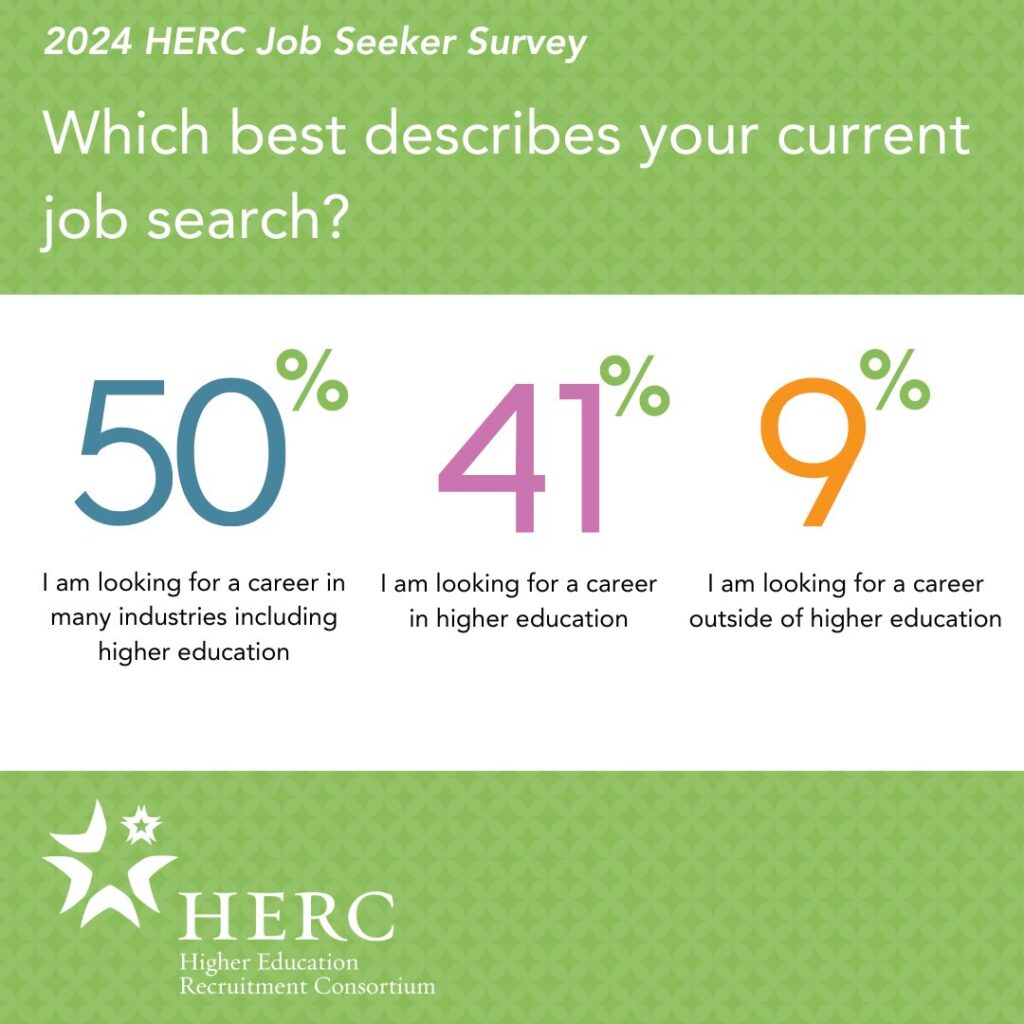
When asked to describe their current job search, 50% of respondents said they were looking for a career in many industries, including higher education, 41% were looking for a career in higher education only, and 9% were looking for a career outside of higher education.

Diversity, equity, and inclusion remain a top priority
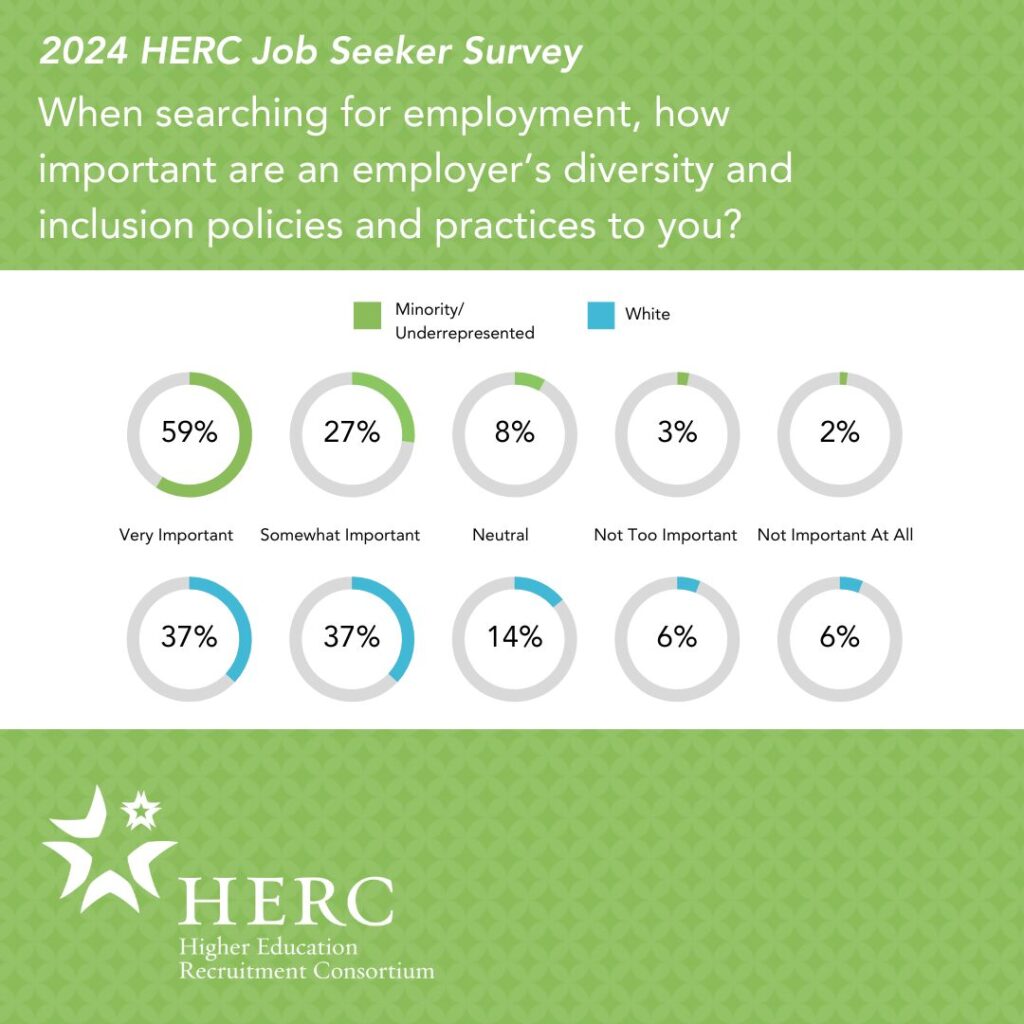
Despite recent attention on DEI efforts in higher ed, most minority & underrepresented (86%) and white (74%) respondents noted that diversity and inclusion policies were important to them. According to survey respondents, salary and compensation equity, having a positive reputation from current employees, and demonstrating that diverse faculty/staff can advance in their careers are the top three indicators of an employer’s commitment to DEI.

Your input about working in higher ed matters to us. Please participate in our monthly quick polls on LinkedIn (follow HERC on LinkedIn) and our annual job seeker survey (the next one will be in early 2025).

Check out Top Articles on HERC Jobs.
Filed Under: Job Seeker Survey Tagged With: Marcia Silva

Higher Ed Job Seekers Want to Feel Valued, Work-Life Balance, Inclusive Workplace

July 16, 2024 by Marketing Director

2024 HERC Job Seeker Survey Report Cover Image

New Report Reveals Key Priorities – Higher Ed Employers Need to Address Aging Workforce and Rising Competition from Non-Higher Ed Sectors

SAN FRANCISCO, CA – As higher education employers continue to assess the impact of recent media attention on higher education, limited budgets, and competition from external employers, a new report from the Higher Education Recruitment Consortium (HERC) provides timely insights into the higher education talent community, including what benefits are most attractive and the impact of campus culture on job interests. [The full report is available to HERC members. If you are interested in accessing the report, please contact Marcia Silva – see info at the bottom.]

The new publication, “2024 HERC Job Seeker Survey Report: What Matters Most – Insights from the Higher Education Talent Community,” shares key takeaways and recommended actions for human resources, academic affairs, and diversity leaders to improve their efforts to find, select, and retain staff and faculty.

The report strongly encourages higher ed employers to pay attention to what job seekers across different stages in their careers want, including pathways for career advancement When looking for a new employer, job seekers place high importance on the ability to advance their careers internally, with 51% stating that it’s very important and 34% stating that it’s somewhat important. These numbers shift significantly when we analyze responses by race/ethnicity, with 63% of Hispanic/Latine(x)(o)(a)/Spanish job seekers, 66% of Black/African-American job seekers, and 72% of Asian job seekers stating that internal career advancement is very important.

“These findings underscore how policy and other structural decisions impact workforce inclusion efforts,” said Jessica Wise, HERC Co-Executive Director. “For instance, we saw a marked difference between the importance of elder care and access to mental health care for specific demographics.”

Job seekers also want employers to recognize the value of current employees – while nearly 75% of job seekers say that improved compensation and benefits could tempt them to seek new employment, only 5% say that there’s nothing their current employer could do to make their role enjoyable.

Other highlights from the report findings include:

  • The active job seeker market has shifted from the trends seen in previous years. The number of respondents who are actively seeking a new job has fallen from 47% in both 2022 and 2023 to 40% in 2024, while those who are open to the right opportunity has continued to slowly but steadily increase, moving from 38% in 2022 to 42% in 2024
  • When asked to describe their current job search, 9% of respondents indicated that they are exclusively looking for jobs outside of higher ed and 41% indicated they are looking for jobs in many industries, emphasizing competition from other employers as well as an opportunity to better retain the current workforce. 
  • The year-over-year data shows that while work modalities are still shifting, the landscape continues to look very different from the norms prior to the pandemic. While in-person work hasn’t changed much, job seekers with flexible/hybrid work modalities have increased from 14% in 2023 to 19% in 2024. With 38% of respondents in remote or flexible roles and the demand for more such opportunities, this is an area of the workforce landscape that seems unlikely to revert to pre-pandemic norms.

The rise in restrictive legislation hasn’t weakened job seekers’ emphasis on potential employers’ policies regarding diversity, equity, and inclusion – 77% of respondents say that DEI policies are very or somewhat important when searching for employment.

“Higher ed employers must develop holistic policies and programs that attract and retain a diverse workforce,” said Wise. “Job seekers continue to place high importance on inclusive workplaces where they are valued, can grow their careers, and thrive as individuals and contributors.”

ABOUT THE HIGHER EDUCATION RECRUITMENT CONSORTIUM: The Higher Education Recruitment Consortium (HERC) is a nonprofit consortium committed to advancing diversity, equity, and inclusion in the higher education workforce. With over 550 colleges, universities, hospitals, research labs, government agencies, and related organizations, HERC works to ensure member institutions are sites of belonging, where all faculty and staff can thrive. HERC provides resources, networking, and outreach programs to attract, hire, and retain a diverse and qualified workforce.

CONTACT: Marcia Silva, Higher Education Recruitment Consortium, marcia@hercjobs.org, 650-417-3193

Filed Under: News

Why I Work in Higher Ed: Tiana Carter, Project Manager

July 8, 2024 by Marketing Director

Why I Work in Higher Ed: Tiana Carter, Project Manager

The “Why I Work in Higher Ed” series features people working in higher education to get an inside perspective of what they do and what inspires them.

Tiana Carter wears multiple hats at Michigan State University. She is a project manager for the university’s Infrastructure Planning and Facilities unit and a research assistant at MSU’s College of Natural Science.  Her career at MSU began 12 years ago, progressing from administrative assistant to office manager, project manager, and eventually co-director of the MSU Women of Color Community.  Tiana graduated from MSU with a Bachelor of Science degree in Neuroscience.

What initially inspired you to consider a career in higher education?

As I received promotions throughout my tenure at the University, I decided to stay in higher education because of the impact I can make on the next generation of students and MSU’s reputation overall. I’ve worked on several campus initiatives and had the opportunity to create efficiencies and fill gaps.

What are some benefits that you’ve found working in higher education?

Higher ed supported me through achieving a bachelor’s degree in Neuroscience while working full time as a project manager in construction.

Can you give an overview of your career path that has led you to where you are today?

I started working in a campus café as a temporary, on-call employee while taking classes at Lansing Community College. I was looking for something more sustainable and decided to send a mass email to various departments on campus with my resume attached. The MSU Infrastructure Planning and Facilities unit responded to me looking for a receptionist. I worked as a receptionist in the construction department until I applied for a full-time position as an Operations Coordinator in 2015. After getting the full-time Operations Coordinator position, I continued to take on more responsibility and my position evolved into a project manager. In 2020, I briefly moved to the MSU WorkLife Office and later returned to the Construction department in 2021 with a similar position. In 2023, I achieved a bachelor’s degree in Neuroscience while working full-time at MSU.

How would you describe the main responsibilities and challenges you face in your current role?

As a project manager, I am responsible for managing the scope, budget, and schedule for each project I’m assigned to. Each project is different, and my involvement can vary in stakeholder communications, design and engineering oversight, organizational strategy, vendor and material procurements, and process efficiency. I am a key stakeholder responsible for initiating and creating all capital projects in multiple systems currently at $35 billion in construction activity. All of my responsibilities require consistent communication, an ability to take initiative, and resourcefulness. The biggest challenges are navigating varying stakeholder priorities and gaining consensus on streamlining processes to support efficient work.

What are the most satisfying and fulfilling aspects of your job?

The nature of my job allows me to work with so many different partners across campus, that we get to learn about current research and campus-wide priorities. I love being a part of something that impacts people now and for lifetimes beyond me.

Most recently, I played a critical role in developing the Multicultural Center on campus, the first freestanding multicultural building at Michigan State University. Together with Brian Mullen, the project manager, I facilitated listening sessions, presented to the board of trustees, managed the organization of the budget and scope, and scheduled and maintained regular stakeholder engagement strategies. I’m excited to see this facility positively impact MSU’s campus culture for generations. In addition, I have been a co-director of the MSU Women of Color Community for 2 years and have developed programs and networking opportunities to support the University’s goals of creating an inclusive environment by retaining diverse talent.  

Is there any advice you received early in your career that has stuck with you and influenced your approach to work?

A few things. Be willing to take initiative and be resourceful! Try to educate yourself or find the answer before asking a colleague. In addition, try to connect the dots. Meaning, bring together information from different sources. Be open to opportunities – honing in on your professional goals and knowing the steps to get there is important. Networking is important – it can be extremely beneficial to keep a good team of mentors and people you look up to or strive to be like professionally.

How would your coworkers describe you?

Trustworthy. Reliable. Knowledgeable. Has Integrity.

Check out Top Articles on HERC Jobs.

Interested in higher ed job opportunities? Explore our job board with about 50,000 job postings and sign up for a free job seeker account.

About the Author: Sara Ermeti has worked in HR leadership for nearly 30 years in various industries such as higher education, NFP, Religious, Financial, Entertainment, and Transportation. She is also an adjunct professor teaching courses in HR and Business. Sara is a certified coach and resume writer offering individual and business consulting through Esperto HR Office.

Filed Under: Higher Education Career Exploration, Job Seeker Success Stories Tagged With: Sara Ermeti

How to Keep Up With Industry Trends and Skill Requirements

July 3, 2024 by Marketing Director

Continuous Learning: Higher ed professionals keeping up with industry trends in a classroom setting

Staying stagnant in a career is rarely the position one wants to take. If you want to move forward or build off what you’re learning in your workplace, you can bolster your resume with continuous learning. Continuing education and professional development can build upon what is already established so that you can remain a strong candidate regardless of your present career position.

Who can benefit from continuous learning

Unless you are nearing the end of your career, it is often a good choice to grow your knowledge and skillset within your industry. The following types of employees certainly would benefit from career learning-

  • The Career Climber – You are ready to move upward and have a strong foundation in education, combined with a solid work history. Now you find yourself in a position where you want to stand out for the next role in your career, whether internally at your current company or with a new company that is hiring. Adding professional development learning to your resume not only shows hiring managers that you are invested in your career growth, but it can also help keep you relevant in a pool of other strong candidates.
  • The Career Pauser – Childcare needs, mental health sabbaticals, eldercare help, and other life events are all reasons that might lead people to pause in their career track. If you find yourself in this stage, then taking steps to remain relevant in the workforce can make the eventual transition back much easier. While some may not have the time or resources to make a big commitment, taking time for a few webinars, free learning courses, or networking lunches are all great ways to build content for your next resume update. 
  • The Career Assessor – You can tell from the company culture that your job is unstable. You might be seeing the signs of forthcoming layoffs and are looking for ways to ensure that you remain employed as long as possible. Even if layoffs are inevitable, having more talking points for any potential interviews is an excellent way to add to your strong skillset.

Funding your career growth

Money can often be a roadblock to career education advancement. Continuing education courses are often expensive, depending on your financial budget. While some careers, such as nursing and law, require continuing education, others are left on their own to foot the bill. Here are some options that can make the expense easier to handle:

Employer-funded – Many companies that are invested in their employees offer continuing education reimbursement as a non-salary employee benefit. Some companies even provide college course credits to their employees, which is a valuable resource that can help you toward your goal. For employees who do not outwardly have this benefit, it is still ok to reach out to your employer for financial help. Make the case for how the program/seminar/etc. will directly impact your role and, in turn, the institution’s goals, and hopefully your employer will consider supporting you in this route.

Tax benefits – As previously mentioned, some careers require continuous education. Others may be independently building their career through continuing education. For those who are paying for their educational pursuits, there are some tax adjustments and deductions available to ease the cost. Be sure to study your own tax rules and how they apply to your situation before relying on this benefit.

Free alternatives – Not everyone can afford to add another cost to their current budget. If you find yourself unable to find room in your financial situation for the cost of professional development, consider free alternatives. It may take some research, but free courses can be found online. For example, if you are a market researcher looking to learn how to develop surveys, but the cost of survey design platforms is too high, start with SurveyMonkey. Colleges often host alumni events with learning opportunities that are free to alumni. And finally, networking with a colleague can also be a great way to learn about industry trends, thought leaders, and other resources.

Check out Top Articles on HERC Jobs.

About the Author: Connie Castellucci is a higher ed data analyst consultant. Previously she has worked within higher ed departments and nonprofit organizations addressing recruitment, new school development, and member recruitment needs. 

Filed Under: Career Planning, Professional Development Tagged With: Connie Castellucci

Find it Fast

Join HERC
HERConnect (Member Login)
  • Partners
  • About Us
  • Newsroom
  • Contact Us

Regional HERCS

  • Carolinas
  • Greater Chicago Midwest
  • Metro New York & Southern Connecticut
  • Michigan – Ohio – Western Pennsylvania – West Virginia
  • Mid -Atlantic
  • Midwest
  • Mountain West
  • New England
  • New Jersey – Eastern Pennsylvania – Delaware
  • Northern California
  • Northwest
  • Southeast
  • South Midwest
  • Southern California
  • Upstate New York
© 2000 – 2025 The Higher Education Recruitment Consortium is a project of the Tides Center, a 501(c)3 non-profit organization.
Tides’ State Nonprofit Disclosures
Sitemap | Terms | Privacy Policy
Powered by WSI Digital
Cookie settingsAccept Cookies
We use cookies so that we can remember you and understand how you use our site. If you do not agree with our use of cookies, please change the current settings found in our Cookie Policy . Otherwise, you agree to the use of the cookies as they are currently set....
Privacy & Cookies Policy

Privacy Overview

This website uses cookies to improve your experience while you navigate through the website. Out of these cookies, the cookies that are categorized as necessary are stored on your browser as they are essential for the working of basic functionalities of the website. We also use third-party cookies that help us analyze and understand how you use this website. These cookies will be stored in your browser only with your consent. You also have the option to opt-out of these cookies. But opting out of some of these cookies may have an effect on your browsing experience.
Necessary
Always Enabled
Necessary cookies are absolutely essential for the website to function properly. This category only includes cookies that ensures basic functionalities and security features of the website. These cookies do not store any personal information.
Non-necessary
Any cookies that may not be particularly necessary for the website to function and is used specifically to collect user personal data via analytics, ads, other embedded contents are termed as non-necessary cookies. It is mandatory to procure user consent prior to running these cookies on your website.
SAVE & ACCEPT