

herc jobs logo

JOB SEEKER LOGIN HERCONNECT (MEMBER LOGIN)

Menu
  • Job Seeker Resources
    • Search Jobs
    • Create an Account
    • Career Advice
    • Ebooks
    • Virtual Career Fairs
    • Webinars
    • Dual Careers Resources
    • Inclusive Career Hubs
  • Employer Resources
    • Become a Member
    • Products and Rates
    • Post a Job
    • Regional HERCs
    • Toolkits
  • About Us
Menu
  • Job Seeker Resources
    • Search Jobs
    • Create an Account
    • Career Advice
    • Ebooks
    • Virtual Career Fairs
    • Webinars
    • Dual Careers Resources
    • Inclusive Career Hubs
  • Employer Resources
    • Become a Member
    • Products and Rates
    • Post a Job
    • Regional HERCs
    • Toolkits
  • About Us


Archives for June 2025

You Spoke. We Listened. Highlights From Our Workforce Survey

June 25, 2025 by Marketing Director

Question mark and light bulb icons on wooden cubes

This year, more than 1,300 of you shared your experiences, concerns, and hopes for the future of work in higher education through the 2025 HERC Higher Education Workforce Survey (formerly known as the HERC Job Seeker Survey). Whether you’re actively job searching or just thinking about your next step, your input has helped paint a clearer picture of what today’s workforce really needs.

Thank you for making your voice heard. This year’s survey was our most in-depth yet, with expanded questions on flexibility, community, burnout, and career growth. What we’ve learned from you is both eye-opening and inspiring—and it’s already making a difference in shaping HERC’s work and the efforts of our member institutions.

You’re Exploring Options, But Still Value Higher Ed

One major finding: most job seekers are keeping their options open.

  • 51% are looking at multiple industries, including higher education
  • 39% are focused specifically on careers in higher ed
  • Only 10% are seeking jobs exclusively outside higher education

This is an important reminder for colleges and universities: while many of you are still interested in higher ed, you’re also exploring other fields that offer competitive pay, flexibility, and meaningful work. Institutions that want to attract and retain top talent need to clearly communicate their values, growth opportunities, and inclusive culture.

Top Challenges: Pay, Burnout, and Career Growth

While salary continues to be the top concern, other challenges are shaping how job seekers evaluate potential employers:

  • 51% cited salary and compensation as their top concern
  • 46% said they’re experiencing career stagnation
  • 32% reported burnout or work-related stress

These findings reflect what many of you already know: competitive pay matters, but it’s not the only thing. Lack of growth and high stress levels are prompting many professionals to reevaluate where and how they want to work.

Community and Flexibility Make a Difference

One of the clearest themes in the survey was the importance of workplace community.

  • 90% of respondents said having a sense of community at work is important
  • Over 80% believe it directly impacts job satisfaction

When it comes to flexibility, hybrid work stood out as the most satisfying model:

  • 64% of hybrid workers reported high job satisfaction
  • Hybrid employees also felt a strong sense of connection, nearly on par with in-person workers

The message is clear: job seekers value flexibility, but not at the cost of feeling disconnected. A thoughtful hybrid approach can offer the best of both worlds.

Turning Insights Into Action

This survey wasn’t just about gathering data; it’s about making change. At HERC, we’re using your feedback to improve the tools, resources, and programming we offer to support your career journey. We’re also sharing these findings with our member institutions so they can better understand what candidates want and need.

Here’s what’s already underway:

  • New career resources and tools to help you grow
  • More programming for employers on flexibility, career development, and inclusive practices
  • Continued advocacy for healthier, more supportive workplace cultures across higher education

Your feedback helps shape the future of work in higher education. Whether you’re early in your career or a seasoned professional considering your next move, your voice is powerful, and we’re grateful you chose to share it with us. Please participate in our monthly quick polls on LinkedIn (follow HERC on LinkedIn) and our annual job seeker survey (the next one will be in early 2026).

Check out Top Articles on HERC Jobs.
Filed Under: Job Seeker Survey Tagged With: Marcia Silva

HERC Releases 2025 Workforce Survey Results, Offering Critical Insights to Improve Hiring and Retention in Higher Education

June 25, 2025 by Marketing Director

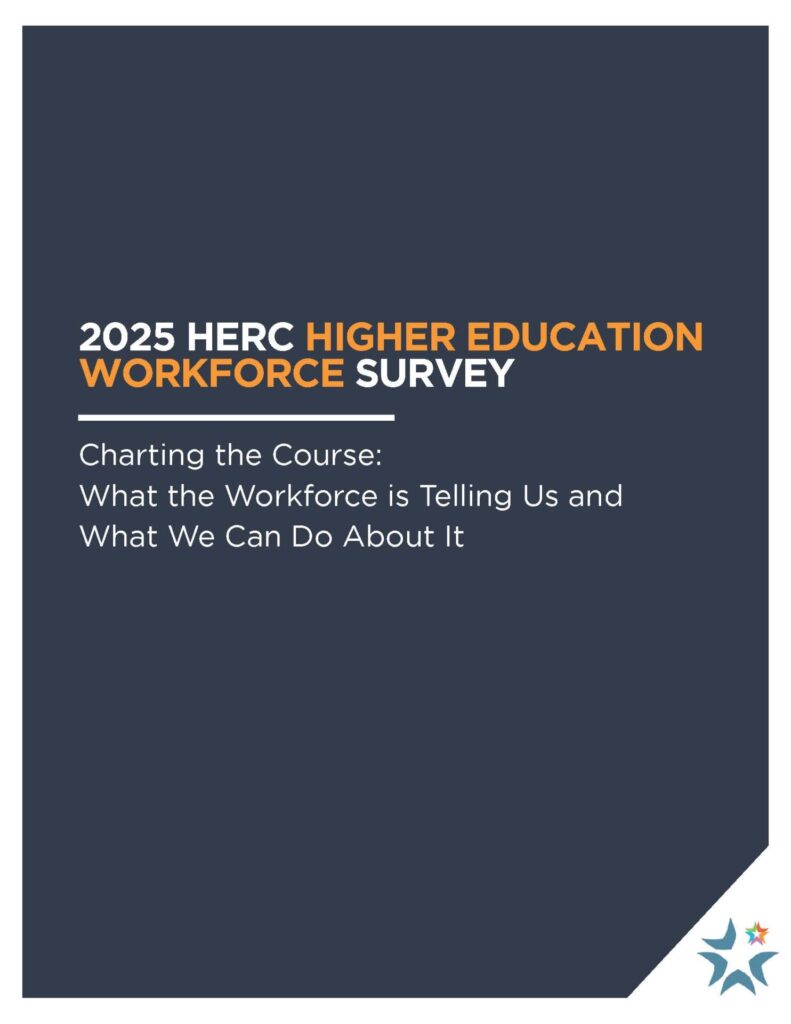
San Francisco, CA — The Higher Education Recruitment Consortium (HERC) has released the findings of its 2025 HERC Higher Education Workforce Survey, providing a data-driven snapshot of the needs, concerns, and motivations of current and prospective employees in higher education. Conducted from February 4 to March 2, 2025, the survey gathered input from 1,322 respondents, providing higher education institutions with valuable insights on attracting and retaining talent in a highly competitive market. [The full report, Charting the Course: What the Workforce is Telling Us and What We Can Do About It, is available to HERC members. If you are interested in accessing the report, please contact Marcia Silva – see info at the bottom.]

The findings support what many in higher education have long suspected: that culture, flexibility, and a sense of belonging are just as important as salary, if not more so. Organizations that invest in these key areas tend to keep their employees longer and are more competitive when attracting talent.

“Our members are already doing the hard work, but sustaining progress takes more than commitment. It takes practical tools, trusted insights, and shared solutions,” said Jessica Wise, Co-Executive Director and Director of Programs of HERC. “That’s why we produced this report, to help institutions move from data to direction, and from insight to impact. Real change is possible when we focus on what’s doable and do it together.”

The annual survey, formerly known as the HERC Job Seeker Survey, was expanded this year to provide a more nuanced understanding of workplace experiences. It included new and refined questions on employee connection, community, flexibility, and well-being, creating a more holistic picture of what today’s higher ed workforce expects from their employers.

Higher Ed in a Broader Talent Market

One of the most revealing data points from the 2025 survey is how candidates are approaching their job search:

  • 51% of respondents are exploring opportunities across multiple industries, including higher education.
  • 39% are actively seeking careers specifically within higher education.
  • Only 10% are looking exclusively outside higher education.

These numbers highlight both the challenge and the opportunity for colleges and universities. While higher ed institutions must compete in a broader talent pool, the data makes clear that many candidates haven’t abandoned their interest in higher ed careers. Institutions that communicate their workplace culture, growth opportunities, and mission-driven impact have a strong chance of attracting talent from this highly flexible pool.

Key Findings: What Today’s Workforce Wants

Beyond job search trends, the 2025 HERC Workforce Survey also sheds light on what’s driving job satisfaction:

  • Salary and compensation remain top of mind, cited by 51% of respondents as their primary concern.
  • Nearly half of respondents (46%) report experiencing career stagnation, with limited growth opportunities.
  • Burnout and stress are significant issues, affecting 32% of respondents.

These challenges underscore the need for institutions to make targeted, structural improvements that go beyond compensation. Investments in career development, workload management, and career advancement pathways could yield significant gains in employee engagement and retention.

The Power of Community and Flexibility

The data also highlights the profound role that workplace community plays in employee satisfaction:

  • 90% of respondents say having a sense of community at work is important, with 61% strongly agreeing and another 29% somewhat agreeing.
  • Over 80% believe workplace community directly impacts their job satisfaction.

When it comes to how people work, hybrid work models emerged as the clear favorite:

  • Hybrid workers reported the highest satisfaction rates (64%) while maintaining strong connection scores (52%), nearly on par with fully in-person workers.
  • This pattern held across key indicators such as workplace relationships and a sense of belonging, indicating that limited on-site engagement can preserve community benefits while still offering valued flexibility.

Looking Ahead: From Insight to Action

HERC will use the results of this year’s survey to inform new programming, resource development, and learning opportunities for its member institutions. Member institutions will also receive suggested strategies to enhance their recruitment and retention efforts.

ABOUT THE HIGHER EDUCATION RECRUITMENT CONSORTIUM: The Higher Education Recruitment Consortium (HERC) is a nonprofit consortium committed to improving higher education recruitment practices and workplace culture to strengthen our institutions and serve our communities With over 550 colleges, universities, hospitals, research labs, government agencies, and related organizations, HERC works to ensure member institutions are sites of belonging, where all faculty and staff can thrive. HERC provides resources, networking, and outreach programs to attract, hire, and retain a qualified, multi-faceted workforce. HERC also helps job seekers find, apply for, and succeed in higher education careers through its website, HERC Jobs.

CONTACT: Marcia Silva, Higher Education Recruitment Consortium, marcia@hercjobs.org, 650-417-3193

Filed Under: News

Job Search Strategy for Uncertain Times

June 10, 2025 by Marketing Director

With five generations now in the workforce and competition from both internal and external candidates, securing a job presents its own challenges and sometimes frustrations. In addition, depending on your targeted industry, current funding sources may be uncertain. However, with a focused job search strategy and a willingness to open yourself to alternative possibilities, gaining a job is within reach.

Resume and Cover Letter

Before starting your job search, the most crucial step is to check your resume to make sure it gives a clear summary of your achievements. Examine your current resume using this evaluation to ensure it is no longer than two pages and only includes your last ten years of employment.

Even though your extensive experience might not be adequately represented in a two-page resume, when you apply for jobs, make sure your material is tailored to each one, including relevant keywords from the job posting.

Your cover letter will be reviewed next.  If a cover letter is required for a position, make sure it is no more than one page and concentrates on the experience you have that is directly related to the job description.  Keep in mind that the cover letter should not be a rehash of your resume, but rather an account of how your professional accomplishments meet their needs.  The individual reviewing your resume and cover letter will be able to determine your suitability for their demands if you customize them to each posting’s requirements. 

Job Search Strategy

Developing a job search strategy comes in second.  Focusing on your goals can help you plan and monitor your progress more effectively and save time on sporadic searches. Making both a primary and secondary plan can help you achieve this.  While the secondary plan offers flexibility to expand your search, the primary plan will concentrate on the specifics of the job you want.

Remember that your next job is just that—your next job. It does not have to be the ideal one; it simply needs to be one that will let you keep developing your network and experience while also sharing your expertise and contributing to the success of an organization.

Let’s begin by drafting the main strategy.  It is helpful to list the qualities you are seeking in your next position during this phase:

  • Job status, i.e., full-time, part-time, or limited-term
  • Compensation – best to think of this as a range
  • Benefits that are key for your lifestyle
  • On-site versus remote or hybrid opportunities,
  • Commute preference, including whether relocating is an option. 
  • Consider what job titles fit your goals
  • What industries, or even a targeted list of employers, to focus on
  • And, lastly, outline what may be deal breakers or those elements of a job or industry that are not desirable

Focusing on opportunities that fit your needs is easier when you are clear about what you are looking for.

Clarity and focus are important, but having a backup plan will provide greater freedom.  This may include a departure from your initial objectives, such as taking on shorter-term positions or supplementary job titles, among other things.

Building Relationships or Networking

Building and maintaining long-term relationships is crucial, even if this approach frequently carries a bad connotation and may make people uncomfortable being vulnerable when reaching out. The goal of networking is to build relationships for the duration of your career, not just to inquire about job openings. Building new relationships is important, but do not forget to use your existing network, and do not be afraid to express interest in a new job. Information about the hidden job market—those positions that are open but might not be advertised—will frequently be shared via this network.

Building relationships is essential for understanding the hiring cycles of companies or industries, learning about current and potential job openings that may not be posted, and gaining insight into employers that are not already on your plan, regardless of how much time you spend looking for a job.  Additionally, your new contacts might occasionally be able to recommend others.  Remember that every individual you encounter becomes an extension of your job quest. However, keep in mind that partnerships require both giving and receiving; they are not one-sided.

There are numerous ways to meet new people, even though putting yourself out there might not feel comfortable.  Attending job fairs, joining associations related to your career (e.g., AMA for Marketing, Paralegal Associations, Fundraising Associations, SHRM), contacting your alumni group, going to events with your local Chamber of Commerce YPN, taking part in events that align with your interests and hobbies (e.g., Meetups), and volunteering are all opportunities to consider.

Even though applying online alone might get you an interview, putting yourself out there will increase your chances of securing the job you desire and possibly in a shorter timeframe.

LinkedIn and Social Media

In the same way that you are looking for a new position, businesses also utilize special recruitment efforts. They use social media platforms, like LinkedIn, to post openings and look for passive prospects. Be sure to participate in any forums with employers sharing your objectives. Join groups, interact with others, and actively use the search function to locate peers and job openings.

LinkedIn profiles give you more freedom to describe your whole job experience and much more, whereas resumes must be no more than two pages. Make the most of your profile by telling your narrative in the overview section and then going into depth about your training, credentials, experience, and other relevant information. LinkedIn makes it simple to look for employers and colleagues, as well as build a professional profile.   

Create posts using this resource to establish yourself as an authority in your field.  Being active on all professional and social media platforms is essential to making sure you are seeing the most recent information on job openings and businesses.

Additionally, a variety of job boards are accessible, such as Indeed, Glassdoor, and Zip Recruiter.  You can use job boards to create a general and a targeted job search. However, when you come across a job that interests you, it is best to visit the employer’s website to learn more about their goals and mission, ensure the position is open, and apply directly there.

Tracking

The job search process can take months and involve a lot of applications and ongoing networking. Keeping track of application submissions, their status, the people you have met, and their contact details in a spreadsheet helps you identify what efforts are working and where you need to change your approach.  Keep track of the applications you have sent and establish a file for housing employment postings.  You can review and rehearse from the posting if selected for an interview.

Lastly, please be patient with yourself; it may take three months to a year to find a job.  Employers are becoming more selective in their hiring practices and postings, which can be difficult for job seekers. Still, it can also be comforting to know that you are not doing anything incorrectly.

Check out Top Articles on HERC Jobs.

About the Author: Sara Ermeti has worked in HR leadership for nearly 30 years in various industries such as higher education, NFP, Religious, Financial, Entertainment, and Transportation. She is also an adjunct professor teaching courses in HR and Business. Sara is a certified coach and resume writer offering individual and business consulting through Esperto HR Office.

Filed Under: CV/Resume Advice, Job Search, Networking Tagged With: Sara Ermeti

Don’t Just List Names – Build a Strong Professional Reference List

June 6, 2025 by Marketing Director

Checking Professional Reference List

When you update your resume and prepare responses to potential job interview questions, don’t forget your professional reference list! Having a strong list of references can make a big difference in advancing during the job interview process. I recently spoke to an HR recruiter who shared a story of a candidate they were strongly considering. When they reached out to one of the candidate’s references, it turned out the person did not exist.

Whether that candidate told a lie or provided incorrect information, there are three steps you can take to avoid encountering any issues with a potential employer contacting your professional references.

1. Connect and Stay in Touch

The first step is figuring out who to include on your professional reference list. It’s great to have made at least one professional connection at each job listed on your resume, but ultimately, you should aim to have at least three references on your list. Ideally, this person should be your direct supervisor or manager. If this is not possible, choose a direct teammate or a colleague in your department. If that is also not feasible, find someone in another department and be sure to follow Step 3 below.

Again, ideally, you’re already in touch with this person, whether it’s exchanging emails over the years or being connected on LinkedIn. Pro tip: Always try to establish that LinkedIn connection as soon as you sense that the person would be good to have in your professional network.

Make it a point to keep in touch with former colleagues because you never know when you might need to ask them for a favor. If you prefer not to reach out semi-regularly, remember that being connected on LinkedIn means your contacts may see your posts or interactions with others. This serves as a reminder to be active on LinkedIn! Seeing your activity can remind them of you and help them feel more connected since you worked together.

2. Provide Advance Notice and Ask for Permission

Before adding individuals to your professional references list that you intend to provide to a potential employer, ensure you reach out to them and obtain their permission to include them on your list first.  No one likes to be caught off guard by an employer who wants to ask questions about a direct report or a former coworker that they’re not even sure they remember.

Reaching out serves multiple purposes. It gives a potential reference a chance to jog their memory and remember who you are, provides them with time to consider whether they wish to be listed as a reference, and allows you to obtain current contact information (providing outdated or non-working contact details leaves a poor impression on a potential employer).

3. Prep References for Your Success

One of the most underestimated (and arguably the most impactful) steps is equipping your references with tools and resources that support your case for being the best candidate for the position. Share the job listing and explain why you want the role. Help them understand why you are a good fit for this opportunity. Suggest specific projects or skills that you’d like them to communicate to the potential employer.

For a reference that didn’t work directly with you and who may be more of a personal than a professional connection, be sensible and considerate. Provide talking points that speak to your qualifications that they’d feel comfortable speaking to. Consider these questions: In what way did they observe your job performance? How does their viewpoint reflect your professional skills?

Your references are often busy with their personal and professional lives and won’t have the time to reflect on when they worked with you. Giving them talking points and reference materials will make it much easier for them to express what you hope they’ll say, and they’ll genuinely appreciate not having to do all the homework.

With all the different things you must do to apply for and secure a job, putting together a professional reference list can seem like an afterthought. As someone who’s been both a reference and a reference-checker, the individuals you choose and how they speak about you can exponentially increase your chances of getting that new job.

If your professional contacts agree to be a reference, they want to help you get the position and can serve as your greatest cheerleaders. Invest in building strong relationships throughout your career, showing intention and care. When you need them to be a reference, give them the information they need to effectively highlight your qualifications and experiences.

Check out Top Articles on HERC Jobs.

About the Author: Marcia Silva is the director of marketing and communications at the Higher Education Recruitment Consortium. She strives to create engaging, research-informed content that empowers job seekers and employers committed to creating inclusive workplaces. She is passionate about using digital media and technology to encourage participation and strengthen communities.

Filed Under: Interviewing, Networking, Top Articles Tagged With: Marcia Silva

Find it Fast

Join HERC
HERConnect (Member Login)
  • Partners
  • About Us
  • Newsroom
  • Contact Us

Regional HERCS

  • Carolinas
  • Greater Chicago Midwest
  • Metro New York & Southern Connecticut
  • Michigan – Ohio – Western Pennsylvania – West Virginia
  • Mid -Atlantic
  • Midwest
  • Mountain West
  • New England
  • New Jersey – Eastern Pennsylvania – Delaware
  • Northern California
  • Northwest
  • Southeast
  • South Midwest
  • Southern California
  • Upstate New York
© 2000 – 2025 The Higher Education Recruitment Consortium is a project of the Tides Center, a 501(c)3 non-profit organization.
Tides’ State Nonprofit Disclosures
Sitemap | Terms | Privacy Policy
Powered by WSI Digital
Cookie settingsAccept Cookies
We use cookies so that we can remember you and understand how you use our site. If you do not agree with our use of cookies, please change the current settings found in our Cookie Policy . Otherwise, you agree to the use of the cookies as they are currently set....
Privacy & Cookies Policy

Privacy Overview

This website uses cookies to improve your experience while you navigate through the website. Out of these cookies, the cookies that are categorized as necessary are stored on your browser as they are essential for the working of basic functionalities of the website. We also use third-party cookies that help us analyze and understand how you use this website. These cookies will be stored in your browser only with your consent. You also have the option to opt-out of these cookies. But opting out of some of these cookies may have an effect on your browsing experience.
Necessary
Always Enabled
Necessary cookies are absolutely essential for the website to function properly. This category only includes cookies that ensures basic functionalities and security features of the website. These cookies do not store any personal information.
Non-necessary
Any cookies that may not be particularly necessary for the website to function and is used specifically to collect user personal data via analytics, ads, other embedded contents are termed as non-necessary cookies. It is mandatory to procure user consent prior to running these cookies on your website.
SAVE & ACCEPT