

herc jobs logo

JOB SEEKER LOGIN HERCONNECT (MEMBER LOGIN)

Menu
  • Job Seeker Resources
    • Search Jobs
    • Create an Account
    • Career Advice
    • Ebooks
    • Virtual Career Fairs
    • Webinars
    • Dual Careers Resources
    • Inclusive Career Hubs
  • Employer Resources
    • Become a Member
    • Products and Rates
    • Post a Job
    • Regional HERCs
    • Toolkits
  • About Us
Menu
  • Job Seeker Resources
    • Search Jobs
    • Create an Account
    • Career Advice
    • Ebooks
    • Virtual Career Fairs
    • Webinars
    • Dual Careers Resources
    • Inclusive Career Hubs
  • Employer Resources
    • Become a Member
    • Products and Rates
    • Post a Job
    • Regional HERCs
    • Toolkits
  • About Us


Archives for November 2021

Do’s and Don’ts for Following Up on Your Application

November 10, 2021 by Marketing Director

Male professional reading laptop screen

You found a job opportunity that matches what you’re looking for, at an institution that you’ve been eyeing for months. You submitted your cover letter and resume and received an automated email confirming receipt.  Two weeks have passed, and you still haven’t heard from a real person, which surprises you – you thought you were a strong candidate. What can you do? Are there things that you should avoid doing?

Don’t Assume You’re Being Ignored

Only getting an automated response to your application submission can be annoying, but there are many possible reasons why you haven’t heard from a real person yet. Your application could still be sitting in an inbox, unopened.

Some institutions have extensive hiring processes that require leaving job postings up for a certain amount of time before they can take them down. Going through applications to identify strong candidates can also take a long time, especially if multiple people are involved. Check the original job listing for any information about the institution’s hiring process and timeline.

Another possible reason for a delayed response is that many HR departments are short-staffed, making a long process even longer. Like other sectors, higher ed is experiencing staffing shortages during the COVID pandemic.

Do Find a Contact Person

Reaching out for an update on your application status is completely acceptable. First, figure out who to follow up with. Check if there’s a hiring manager listed in the job posting. There may also be a note to NOT contact the hiring manager. If that is the case, do follow that guidance otherwise you could hurt your chances of being considered.

If you can’t find a real person to contact in the job posting, check your personal connections. Do you know anyone that works at the institution? If you do, they may be able to find out who the hiring manager is.

If your personal connection can’t link you directly to the hiring manager, ask them to put in a good word about you, which could be better than your own direct follow-up message. It might also be in your connection’s interest to help you if the institution has an employee referral program.

If no hiring manager is listed and you don’t have any contacts working at the institution, then do research online to locate a recruiter or someone in HR. Check the institution’s website or find the institution on LinkedIn and go through its list of people/employees. 

Do Send a Follow-Up Message via Email or LinkedIn

Many hiring experts recommend waiting about two weeks after you’ve submitted your application to send any kind of follow-up message. A written message is preferred over a phone call because it shows that you respect that person’s time, plus it gives you some space to make your personal pitch.

Your message should succinctly confirm your interest in (and excitement about) the position, highlight your most relevant experiences and skills, and express gratitude for their time. This could be your first impression on the hiring manager. Your message should be strong and compelling enough to get them to WANT to find your application in their inbox.

If you don’t get a response to your message, wait another two weeks to send a short and final follow-up to double down on your interest and qualifications.

Don’t Be Hard on Yourself

It isn’t fun to feel like you won’t get closure on a job opportunity that you felt was perfect for you. The waiting and uncertainty can take their toll on your mental health – take a break from job searching when you need it. And when you’re ready to, resume your search; better opportunities are out there. Be patient and diligent and the right job will eventually appear in your job search.

Want CV/resume and cover letter tips? Download our free ebook, How to Apply for Higher Education Careers (Revised Edition).

Check out more Top Articles on HERC Jobs.

About the Author: Marcia Silva is the director of marketing and communications at the Higher Education Recruitment Consortium. She strives to create engaging, research-informed content that empowers job seekers and employers committed to creating inclusive workplaces. She is passionate about using digital media and technology to encourage participation and strengthen communities.
Filed Under: CV/Resume Advice, Job Search, Networking, Top Articles Tagged With: Marcia Silva

How an English Major Succeeded in a STEM Field

November 8, 2021 by Marketing Director

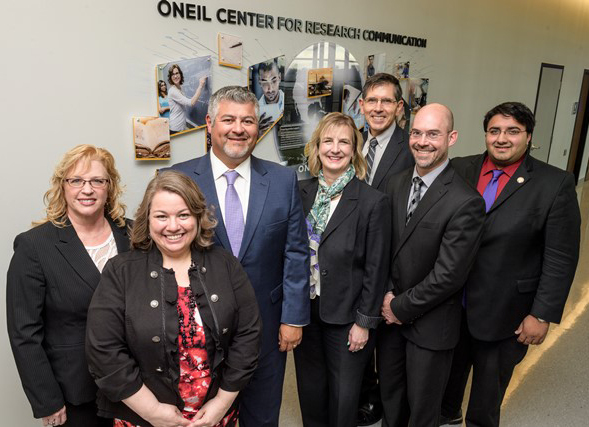
ONEIL Center for Research Communication opens at Wright State University. Brandy Foster, executive director of the ONEIL Center for Research Communication is pictured second from left. (Photo by Erin Pence)
ONEIL Center opening at Wright State University. Brandy Foster, executive director of the Center, is pictured second from left. (Photo by Erin Pence)

STEM jobs are in high demand, while STEM professionals can be in short supply. English major Brandy Foster explains how you can break into a STEM field, even with a background in humanities.

I’d been intending to get my doctoral degree in 19th century British literature. I love Jane Austen—I thought I was going to be an Austen scholar and there’s a lot about that life that would still appeal to me—but a career-altering experience made me take a different path.

When I was an undergraduate English major at Wright State University, I was recruited by a mechanical engineering professor who had a really successful and prolific graduate research group, many of whom were non-native English speakers because they were international graduate students. And he was really frustrated that he was spending way too much of his time trying to correct language in proposals and dissertations and journal articles, and that wasn’t his strength or his interest, so he recruited me from the writing center at the university.

I was embedded in that group for a few years and I learned informally a lot of the genres of technical writing, and how to find my way in this really unfamiliar landscape of STEM. I had no prior inclination of working with mechanical engineers, so that experience changed the entire trajectory of my career. I was able to land that first job after graduating with my master’s as the proposal writer for the College of Engineering and Computer Science because by that time I really understood and excelled at writing proposals to the National Science Foundation and the Department of Defense.

I found my place by demonstrating the value that someone who has a humanities background can bring to STEM and ultimately ended up as a senior lecturer in the department of computer science and engineering. Here’s how you can too:

Find Your Place

I wasn’t a computer scientist or engineer. I didn’t know how to program, and I wasn’t proficient in math. But I understood the social implications of STEM and technology. And I also was really attracted to the type of innovation that they do in computer science and engineering. It all seemed so cutting edge, and so I was able to model that in my own way and innovate within my job, and in what has turned out to be really, really fun initiatives.

Think Critically

You really have to understand how to attack a project or a problem. Imagine that you’re in an unfamiliar landscape—if you’re an English major, that might be a STEM topic. Or if you’re an engineer, that might be something related to medicine. We train our students on how to draw on the skills from their individual programs that cut across communication—problem-solving, critical thinking, and empathy are really huge.

Be Sensitive

STEM is significantly different from the humanities. The culture is different, the language is different, the genres are different, and the people are different. Certain personality types gravitate toward one or the other. So I think it’s having that sensitivity to cultural differences that we all should have and whatever way we engage with something that’s unfamiliar to us. So a high degree of sensitivity and empathy and then also confidence in our own ability to contribute.

Know Your Value

When we’re making a big switch, we might focus more on what we might perceive as our challenges, because we’re not the same as the people inhabiting that unfamiliar space. English majors are not the same as an engineer. But instead of focusing on the ways that we’re different, I think it was really important for me to understand what I had to contribute. My diverse perspective from theirs was something that could benefit the organization, and vice versa—I had a lot to learn from them as well. So I think that’s really important, just that sensitivity to cultural differences and that willingness to take that kind of risk.

Check out more Top Articles on HERC Jobs.

Brandy Foster is concurrently the executive director of two major centers, The ONEIL Center at Wright State and the Emergence Center at the university’s foundation, and a senior lecturer in the Department of Computer Science & Engineering at Wright State University, where she earned baccalaureate and master’s degrees in English Language & Literatures.

Filed Under: Career Advice, Higher Education Career Exploration, Job Search, Job Seeker Success Stories, Staff Career Advice, Top Articles, Women Tagged With: Harold Gutmann

Find it Fast

Join HERC
HERConnect (Member Login)
  • Partners
  • About Us
  • Newsroom
  • Contact Us

Regional HERCS

  • Carolinas
  • Greater Chicago Midwest
  • Metro New York & Southern Connecticut
  • Michigan – Ohio – Western Pennsylvania – West Virginia
  • Mid -Atlantic
  • Midwest
  • Mountain West
  • New England
  • New Jersey – Eastern Pennsylvania – Delaware
  • Northern California
  • Northwest
  • Southeast
  • South Midwest
  • Southern California
  • Upstate New York
© 2000 – 2025 The Higher Education Recruitment Consortium is a project of the Tides Center, a 501(c)3 non-profit organization.
Tides’ State Nonprofit Disclosures
Sitemap | Terms | Privacy Policy
Powered by WSI Digital
Cookie settingsAccept Cookies
We use cookies so that we can remember you and understand how you use our site. If you do not agree with our use of cookies, please change the current settings found in our Cookie Policy . Otherwise, you agree to the use of the cookies as they are currently set....
Privacy & Cookies Policy

Privacy Overview

This website uses cookies to improve your experience while you navigate through the website. Out of these cookies, the cookies that are categorized as necessary are stored on your browser as they are essential for the working of basic functionalities of the website. We also use third-party cookies that help us analyze and understand how you use this website. These cookies will be stored in your browser only with your consent. You also have the option to opt-out of these cookies. But opting out of some of these cookies may have an effect on your browsing experience.
Necessary
Always Enabled
Necessary cookies are absolutely essential for the website to function properly. This category only includes cookies that ensures basic functionalities and security features of the website. These cookies do not store any personal information.
Non-necessary
Any cookies that may not be particularly necessary for the website to function and is used specifically to collect user personal data via analytics, ads, other embedded contents are termed as non-necessary cookies. It is mandatory to procure user consent prior to running these cookies on your website.
SAVE & ACCEPT