

herc jobs logo

JOB SEEKER LOGIN HERCONNECT (MEMBER LOGIN)

Menu
  • Job Seeker Resources
    • Search Jobs
    • Create an Account
    • Career Advice
    • Ebooks
    • Virtual Career Fairs
    • Webinars
    • Dual Careers Resources
    • Inclusive Career Hubs
  • Employer Resources
    • Become a Member
    • Products and Rates
    • Post a Job
    • Regional HERCs
    • Toolkits
  • About Us
Menu
  • Job Seeker Resources
    • Search Jobs
    • Create an Account
    • Career Advice
    • Ebooks
    • Virtual Career Fairs
    • Webinars
    • Dual Careers Resources
    • Inclusive Career Hubs
  • Employer Resources
    • Become a Member
    • Products and Rates
    • Post a Job
    • Regional HERCs
    • Toolkits
  • About Us


Archives for June 2023

What Would Make You Stay? (2023 HERC Job Seeker Survey Results)

June 13, 2023 by Marketing Director

Hand placing blocks with different emojis printed on them

What do job seekers think about working in higher education? For those already working in higher education, are they committed to staying or are they looking to leave? What can higher ed employers do to attract and keep employees?

Our annual job seeker survey aims to gain insight from current and potential employees in higher education and identify practical and effective strategies that employers can do to find, select, and retain staff and faculty.

As employers continue to work on their ability to shift talent and resources to tackle their most pressing workforce challenges, they face talent shortages and employee burnout. Based on the results of our 2023 HERC Job Seeker Survey, we published a report with insights and recommendations for HR, academic affairs, and diversity leaders to meet the needs and expectations of job seekers today.

Below, we highlight some of our survey findings and takeaways.

Who Responded

The survey had 1,572 respondents, who reported these demographics:

  • 70% hold master’s degrees or higher
  • 37% are people of color
  • 21% are individuals with disabilities
  • 11% are veterans
  • 64% are women; 35% are men
  • 17% are 22-32, 30% 33-43, 26% 44-54, 21% 55-65, and 5% 66-76 (under 22 and 77+ not shown due to low reporting)
  • 49% are staff/administrators, 29% faculty members, 8% are graduate students/postdocs, 14% are currently working as both staff/administrators and faculty members

Higher ed job seekers are looking across industries.
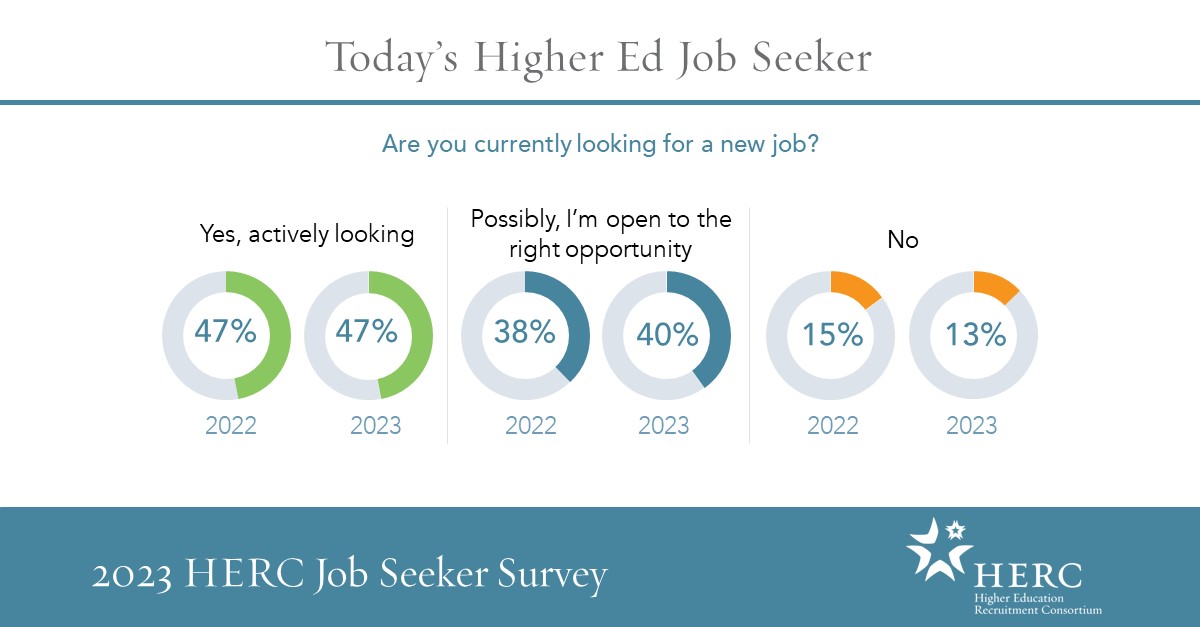
2023 HERC Job Seeker Survey Results: Are you currently looking for a new job?

The active job seeker market is very similar to last year. The same percentage of respondents (47%) were actively looking for a job this year compared to 2022. Only a slightly higher percentage reported possibly searching if the right opportunity was available (40% vs. 38%).

Of the 87% of survey respondents that noted they were actively or passively job searching, 65% were not exclusively seeking opportunities in higher education. Another revealing datapoint is that only 26% of 22-32-year-olds were focused on higher ed jobs only.

The higher education workforce does not feel connected and valued.
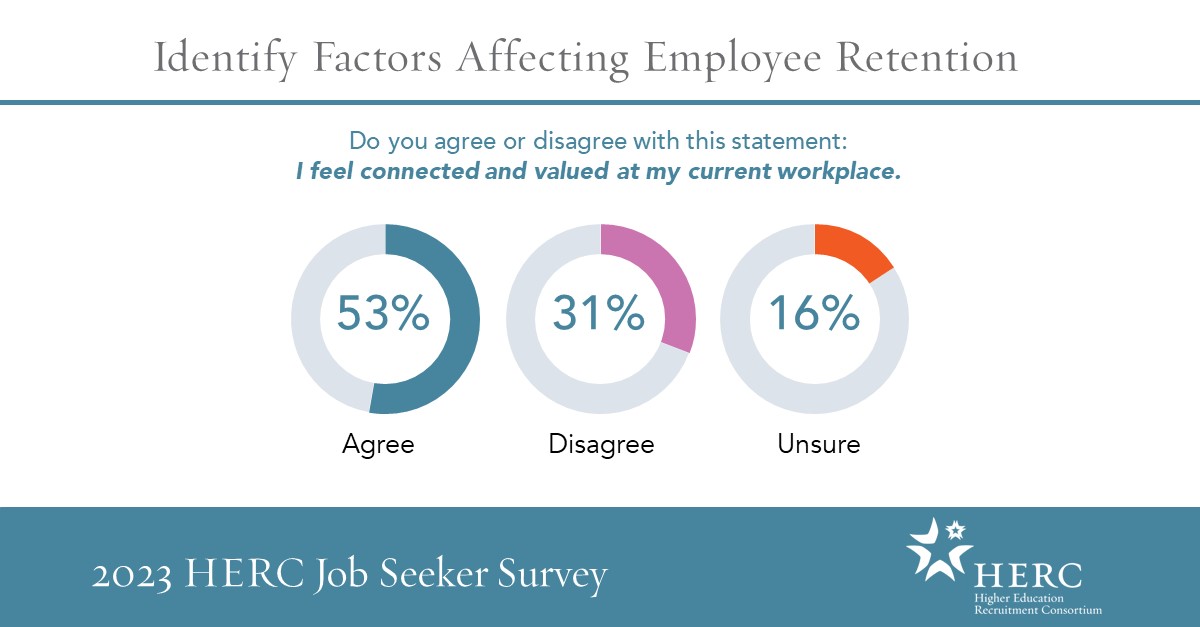
2023 HERC Job Seeker Survey Results: Feeling Connected and Valued at My Current Workplace

When asked if they agree or disagree with this statement, “I feel connected and valued at my current workplace,” 53% agreed, while 31% disagreed and 15% were unsure. When looking at what sector these respondents currently worked in, those working in colleges or universities had the lowest percentage agreeing with the statement (49%).

Diversity, equity, and inclusion remain a top priority.
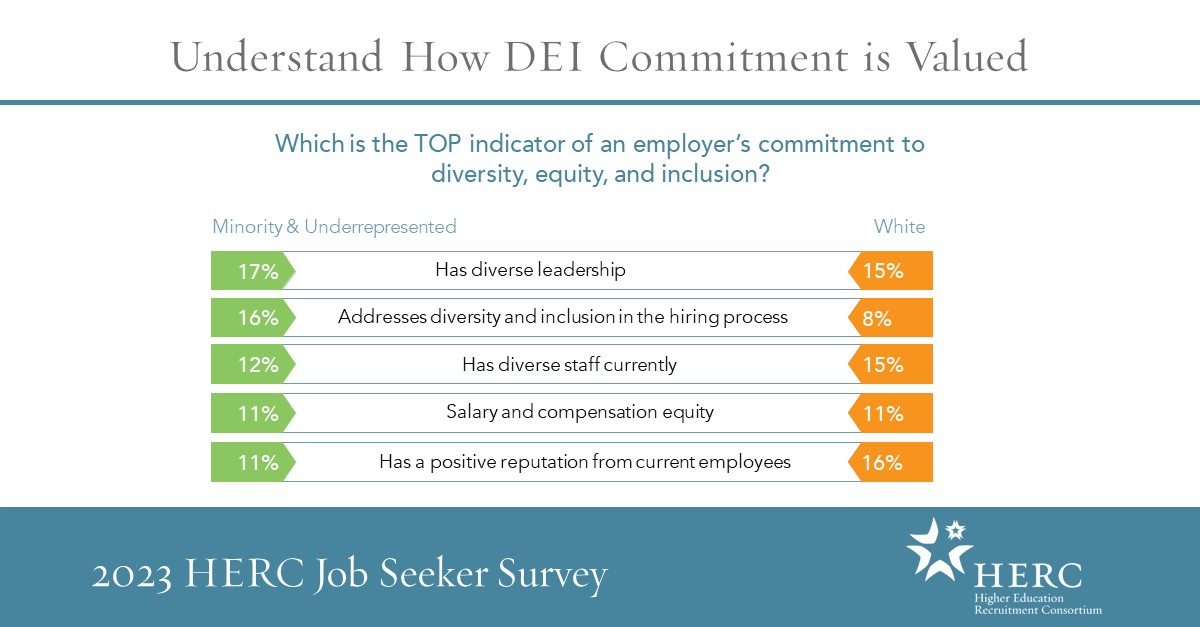
The majority of minority & underrepresented (85%) and white (77%) respondents noted that diversity and inclusion policies were important to them. Having diverse leadership, addressing diversity and inclusion issues in the hiring process, and having a diverse staff currently are the top three indicators of an employer’s commitment to DEI according to minority and underrepresented respondents.

Your input about working in higher ed matters to us. Please participate in our monthly quick polls on LinkedIn (follow HERC on LinkedIn) and our annual job seeker survey (the next one will be in early 2024).
Filed Under: Job Seeker Survey

Higher Ed Job Seekers Value Supportive Leadership, Healthy Workplace Cultures; Highly Willing to Relocate

June 13, 2023 by Marketing Director

2023 HERC Job Seeker Survey Report: Get Insights on Higher Ed Job Seekers

New Report Highlights Increasing Competition for Stagnant Higher Ed Candidate Pool

SAN FRANCISCO, CA – As recruitment and retention remain top of mind for higher education employers, a new report from the Higher Education Recruitment Consortium (HERC) provides a timely pulse check on today’s higher ed job seekers. [The full report is available to HERC members. If you are interested in accessing the report, please contact Marcia Silva – see info at the bottom.]

The new publication, “2023 HERC Job Seeker Survey Report: Understanding the Higher Ed Workforce,” shares key takeaways and recommended actions for human resources, academic affairs, and diversity leaders to improve their efforts to find, select, and retain staff and faculty.

“We know from our survey that current and prospective higher ed employees want a supportive workplace that values and rewards their contributions,” said Jessica Wise, HERC Co-Executive Director. “Higher ed employers must be responsive to these needs and this report provides data-informed insights to identify new interventions and make workforce planning decisions.”

The report provides insights on the current job seeker landscape, factors affecting employee retention, and the value of diversity and inclusion workplace efforts. Some of the trends are consistent year over year, such as higher ed job seekers finding remote jobs attractive, but new data has emerged that could help inform how higher education institutions conduct their recruitment and retention activities and where to invest their time and resources.

Highlights from the report findings include:

  • Higher ed job seekers are looking across industries. Of the 87% of survey respondents that noted they were actively or passively job searching, 65% were not exclusively seeking opportunities in higher education. Another revealing datapoint is that only 26% of 22-32-year-olds were focused on higher ed jobs only.
  • The higher education workforce does not feel connected and valued. When asked if they agree or disagree with this statement, “I feel connected and valued at my current workplace,” 53% agreed, while 31% disagreed and 15% were unsure. When looking at what sector these respondents currently worked in, those working in colleges or universities had the lowest percentage agreeing with the statement (49%).
  • Diversity, equity, and inclusion remain a top priority. The majority of minority & underrepresented (85%) and white (77%) respondents noted that diversity and inclusion policies were important to them. Having diverse leadership, addressing diversity and inclusion issues in the hiring process, and having a diverse staff currently are the top three indicators of an employer’s commitment to DEI according to minority and underrepresented respondents.
  • Job seekers are open to moving for a job opportunity. Nearly half (47%) of survey respondents are willing to relocate for a new job. Of those open to relocating, a substantial percentage of job seekers (38%) are willing to move anywhere in the United States for a new job.

“For a variety of reasons, higher ed employers have had to reassess their policies and programs that attract and keep a diverse workforce,” said Wise. “Our ability to reach and engage job seekers gives us unique access to insights from this talent community.”

ABOUT THE HIGHER EDUCATION RECRUITMENT CONSORTIUM: The Higher Education Recruitment Consortium (HERC) is a nonprofit consortium committed to advancing diversity, equity, and inclusion in the higher education workforce. With over 700 colleges, universities, hospitals, research labs, government agencies, and related organizations, HERC works to ensure member institutions are sites of belonging, where all faculty and staff can thrive. HERC provides resources, networking, and outreach programs to attract, hire, and retain a diverse and qualified workforce.

CONTACT: Marcia Silva, Higher Education Recruitment Consortium, marcia@hercjobs.org, 650-417-3193

Filed Under: News

Higher Ed Careers for Veterans: Human Resources IT

June 6, 2023 by Marketing Director

Banner with text: Higher Ed Careers for Veterans

Are you exploring higher ed careers for veterans? Meet Tony Whack. He has served the past 19 years in the role of HRIS (Human Resources Information System) Manager at Wright State University.

What made you consider a career in higher education?

I did not specifically seek a career in higher education. While in the military, I had acquired certain skills in the IT field. A position became available as I was approaching the close of my military career and I was fortunate enough to be selected for it.

Did you run into any specific challenges as a veteran transitioning to higher ed and if so how did you manage it/them?

The primary challenge I experienced was adapting to the less-rigid workplace environment when compared to the military. I had to become much more flexible where enforcement of policies and procedures was concerned – “Don’t be so tough!”

Did anything surprise you about working in higher ed that you did not expect? 

I found it difficult to understand how projects could not develop momentum to move forward to completion. Meeting for the sake of meeting, dragging things out, indecision

Tell us about your current role.

I am the HRIS Manager for the Human Resources department at Wright State University. I oversee the HR module of the university’s ERP system and other related HR IT software systems.

What are some of the benefits of working in higher education?

Depending on the institution, the workforce tends to be more formally educated. Working with individuals that are degree holders can be beneficial for everyone.

How do you think being a veteran has served you in this role?

As a career military person, I believe that the experience levels in supervision and management tend to be higher since many military personnel are required to serve in leadership roles at younger ages than one might experience in other workplaces and careers. Adaptability is another advantage that military personnel might have since they are constantly subject to changes in their career fields, locations, cultures, etc.

Did your military experience easily translate into a civilian occupation? If not, did you have to receive additional training and/or certifications?

With the exception of my IT skills, my military responsibilities and experiences were not related to education at all. My IT skills were something I developed to assist me with the administrative functions of my actual job. Once in higher ed, I did seek additional training and certifications related to IT functions. My supervision and management training did translate also.

What similarities are there (if any) between working in higher education and serving in the military?

The feeling of teamwork, comradery, and evolving challenges…all to serve a meaningful purpose that is The military is too broad of an environment to provide a general response. There are some career paths in the military that can translate to higher ed, and there are just as many that have no possible similarity at all. For me, the culture of teamwork, camaraderie and accountability requires that an individual exhibit the behavior that will uphold those values. That can translate to higher ed, and it does to some degree, but not at the levels that exist in the military.

Check out more resources for veterans exploring careers in higher ed.

About the Author: Sara Ermeti has worked in HR leadership for nearly 30 years in various industries such as higher education, NFP, Religious, Financial, Entertainment, and Transportation. She is also an adjunct professor teaching courses in HR and Business. Sara is a certified coach and resume writer offering individual and business consulting through Esperto HR Office.

Filed Under: Career Transitions, Job Seeker Success Stories, Veterans Tagged With: Sara Ermeti

6 Reasons Why You Should Consider Online Learning

June 2, 2023 by Marketing Director

Higher ed professional taking a break from an online learning course, smiling at camera

Are you trying to figure out how to keep building your knowledge and skillset while you balance work and personal responsibilities? Have you explored online learning options?

I’ll never forget when I interviewed for a job opportunity and I got feedback from the recruiter that the hiring manager thought I could do the job, but she didn’t think she could learn anything from me. At that moment, I felt both irritated that such a broad judgment was made on my experience and skills, but I also frustrated because I knew deep down that I hadn’t been the best at keeping on top of trends because of, well, life.

For a variety of reasons, I knew I couldn’t commit to an in-person educational program, but I could start small with some online classes. In case you didn’t know, online learning is the delivery of educational content through digital channels. I researched online learning options related to my field and found a wide range of options, from different types of providers with varying cost levels. I ultimately chose an e-learning provider that met my needs and budget and signed up for a few online classes.

Here’s why you should consider online learning:

1. Strengthen your skills and learn new ones for career advancement.

Catch up on the latest strategies and tools in your field and bolster your confidence. Or perhaps you’re interested in exploring a new career and you can start learning some basics related to it. These are all classes that you can include in your resume or use as evidence for that promotion and/or raise.

2. Fit it in when you can.

Want something quick or a deeper dive? How much time in a day or week can you do? Can you meet at a regular time, or do you prefer to learn at your own pace? You can decide, then find the options that help you achieve a healthy work-life balance.

3. Access top universities and industry-leading companies.

Interested in online courses at Stanford or Yale? Or perhaps you want to get online training from Salesforce or Google. Online learning has made it that much easier to learn more and sign up for these options.

4. Network with peers.

Online learning easily benefits from tools and resources that support online networking. Depending on your selected online learning environment, you may be able to easily connect with your fellow online learners to collaborate, build relationships, and expand your network.

5. Save time and money.

Join your online classes in the comfort of your home, or wherever you might be with your digital device. There’s no need to drive or take public transportation to a learning site. Additionally, you can save when you take advantage of sales and other promotions offered by some e-learning providers.

6. Get the benefits of a life-long learning mindset.

Online learning doesn’t always have to be directly related to your career development. Sign up for something that you’ve always wanted to learn, something practical or fun. Pursuing lifelong learning taps into a human desire for inspiration and challenges and provide new vistas for personal growth.

Online learning isn’t for everyone. Some people need support from the outside to keep them on task and time. For a successful online learning experience, you must be independent and active in finding your own path. If you’re into that, or at least willing to try, I highly recommend that you check it out and see if there’s anything that piques your interest.

Check out more Top Articles on HERC Jobs.

About the Author: Marcia Silva is the director of marketing and communications at the Higher Education Recruitment Consortium. She strives to create engaging, research-informed content that empowers job seekers and employers committed to creating inclusive workplaces. She is passionate about using digital media and technology to encourage participation and strengthen communities.

Filed Under: Career Advice, Career Planning, Networking, Professional Development Tagged With: Marcia Silva

Find it Fast

Join HERC
HERConnect (Member Login)
  • Partners
  • About Us
  • Newsroom
  • Contact Us

Regional HERCS

  • Carolinas
  • Greater Chicago Midwest
  • Metro New York & Southern Connecticut
  • Michigan – Ohio – Western Pennsylvania – West Virginia
  • Mid -Atlantic
  • Midwest
  • Mountain West
  • New England
  • New Jersey – Eastern Pennsylvania – Delaware
  • Northern California
  • Northwest
  • Southeast
  • South Midwest
  • Southern California
  • Upstate New York
© 2000 – 2025 The Higher Education Recruitment Consortium is a project of the Tides Center, a 501(c)3 non-profit organization.
Tides’ State Nonprofit Disclosures
Sitemap | Terms | Privacy Policy
Powered by WSI Digital
Cookie settingsAccept Cookies
We use cookies so that we can remember you and understand how you use our site. If you do not agree with our use of cookies, please change the current settings found in our Cookie Policy . Otherwise, you agree to the use of the cookies as they are currently set....
Privacy & Cookies Policy

Privacy Overview

This website uses cookies to improve your experience while you navigate through the website. Out of these cookies, the cookies that are categorized as necessary are stored on your browser as they are essential for the working of basic functionalities of the website. We also use third-party cookies that help us analyze and understand how you use this website. These cookies will be stored in your browser only with your consent. You also have the option to opt-out of these cookies. But opting out of some of these cookies may have an effect on your browsing experience.
Necessary
Always Enabled
Necessary cookies are absolutely essential for the website to function properly. This category only includes cookies that ensures basic functionalities and security features of the website. These cookies do not store any personal information.
Non-necessary
Any cookies that may not be particularly necessary for the website to function and is used specifically to collect user personal data via analytics, ads, other embedded contents are termed as non-necessary cookies. It is mandatory to procure user consent prior to running these cookies on your website.
SAVE & ACCEPT