

herc jobs logo

JOB SEEKER LOGIN HERCONNECT (MEMBER LOGIN)

Menu
  • Job Seeker Resources
    • Search Jobs
    • Create an Account
    • Career Advice
    • Ebooks
    • Virtual Career Fairs
    • Podcasts
    • Webinars
    • Dual Careers Resources
    • Inclusive Career Hubs
  • Employer Resources
    • Become a Member
    • Products and Rates
    • Post a Job
    • Regional HERCs
    • Toolkits
  • About Us
Menu
  • Job Seeker Resources
    • Search Jobs
    • Create an Account
    • Career Advice
    • Ebooks
    • Virtual Career Fairs
    • Podcasts
    • Webinars
    • Dual Careers Resources
    • Inclusive Career Hubs
  • Employer Resources
    • Become a Member
    • Products and Rates
    • Post a Job
    • Regional HERCs
    • Toolkits
  • About Us


Behind the Title: Erin Grace Burns, Communications Consultant

May 21, 2026 by Marketing Director

Text: HERC Jobs Podcast: Let's Talk Higher Ed Careers

Learn how to start or grow your career in higher education with insights from professionals, career coaches, and HR experts. The Let’s Talk Higher Ed Careers podcast, produced by HERC Jobs, explores a variety of campus roles beyond teaching, career growth strategies, and tips for navigating the higher ed job market. Whether you’re new to the field or ready to move up, each episode shares real stories and practical steps to help you align your goals, discover opportunities, and succeed in a fulfilling higher ed career. New episodes drop every two weeks on our YouTube Channel.

In this “Behind the Title” episode of Let’s Talk Higher Ed Careers, host Marcia Silva talks with creative communications strategist Erin Grace Burns about building a mission-driven career in higher education communications. Erin shares her journey from student activism and art school to leading communications efforts at institutions, such as the Pacific School of Religion and UC Berkeley School of Social Welfare, and now as a freelance consultant supporting higher ed and nonprofit organizations.

They discuss what makes higher education a unique workplace, the importance of understanding diverse audiences, and how communications professionals can balance tradition, accessibility, and innovation. Erin also shares insights on emerging trends in higher ed marketing, navigating AI ethically, and why higher education institutions are uniquely positioned to foster dialogue and community in a polarized world.

Watch this “Behind the Title” episode on YouTube and tell us what resonated most in the comments. While you’re there, subscribe to our video podcast series so you never miss a conversation.


Filed Under: Podcasts, Veterans, Videos

Career Stagnation: Sometimes It’s Not Effort, It’s Framing

May 14, 2026 by Marketing Director

Illustration of a frustrated job seeker sitting at a desk with their face planted down on their laptop keyboard

In higher education, long job searches can feel like a failure of persistence. Standard advice suggests increasing application volume or broadening networking efforts, assuming a linear process of effort and reward. However, for many professionals, a stalled search is less a reflection of their qualifications and more a symptom of a translation gap.

Higher education hiring is not a monolithic system; it is a layered landscape of evolving institutional expectations as your career advances. You may find yourself qualified by any objective measure, yet remain stuck because you are not framing your experience in alignment with your career stage.

To overcome this career stagnation, look beyond the sheer volume of your output and focus on your institutional legibility. Regardless of whether you are refining an exhaustive CV or a two-page resume, you can align your materials with the specific analytic lenses committees use to evaluate talent to enhance your application’s readability.

The Higher Education Career Journey in Three Steps

CAREER STAGETHE COMMITEE’S PRIMARY LENSTHE “READABILITY” STRATEGY
Early-CareerCan they execute the mission?Contribution: Reframe duties into student or operational outcomes.
Mid-CareerDoes their signature impact track with our needs?Coherence: Consolidate fragmented experiences into areas of unified expertise (e.g., Equity Initiatives, Systems Improvement, or Student Success).
Senior-LevelHow will they steward the institution?Perspective: Surface institutional judgment regarding enrollment trends, accreditation, and the ability to bridge silos through shared governance and mentorship.

Early-Career: Frame Your Contributions

The Insider: What to Emphasize

If you have spent time in higher education, you may recognize that early-career hiring often operates within closely connected institutional networks. Many roles are filled by candidates already familiar to the department, such as former teaching assistants, graduate assistants, or alumni whose work has been directly observed. In these cases, readability is established through prior relationships and demonstrated performance within the institution.

For candidates within these networks, familiarity can streamline evaluation, since prior work is already understood in context. In practice, this also means ensuring that your materials clearly capture the full range of your contributions, including work outside your immediate role or department, so that your capabilities are not underrepresented.

The Outsider: What to Emphasize

For external candidates, the challenge is translation: You are presenting your experience without shared institutional reference points. The goal is to close that gap by making your work immediately legible in relation to the role, the department’s priorities, and the institution’s mission.

At the same time, external candidates can be particularly compelling when institutions are seeking capabilities or perspectives not already present internally. In these cases, readability also depends on how clearly you convey new expertise, approaches, or experience you would bring into the organization.

  • Translate Tasks into Outcomes: Insiders get hired because a supervisor has already seen their results. To compete, your materials must make those results undeniable. Instead of listing duties like “assisted with student registration,” describe the outcome: “Optimized the registration workflow to reduce student wait times by 20%.”
  • Signal Institutional Alignment: Research the specific student demographics and strategic goals of the school. Use your narrative to show you aren’t just looking for any higher ed job, but that you are ready to grow within this specific position. Whether the mission is first-generation student success or technical workforce development, make your alignment explicit.
  • Disrupt the “Prestige Proxy”: Committees sometimes use institutional pedigree as a mental shorthand for quality. You can disrupt this by highlighting specialized certifications, project-based wins, or in-depth experience. Practical, proven impact can carry more weight than a prestige degree when a department is looking for a stable hire who can handle the actual daily work.

Recommendation: Highlight your contributions and your institutional alignment.

  • Don’t: Just list broad experience like “Experienced in student affairs and office administration.”
  • Do: Include results “Streamlined student outreach for the [Specific Program] by implementing a new CRM, resulting in a 15% increase in engagement.”
  • Do: Highlight related work that fits the institutional culture.
    • Explicitly link your background to the specific mission of the university (e.g., the difference between a regional state school and a private research institution).
    • Demonstrate that you are a “stabilizer” who intends to master and evolve in the role.

Mid-Career: Frame Your Impact and Areas of Expertise

At mid-career, the question changes. It is no longer simply what can you do? but what are you known for?

If the early career is about proving you can handle the work, mid-career is where many professionals hit a wall of fragmentation. In higher ed, it is common to accumulate seemingly random experiences where you’ve served on a dozen committees, managed disparate programs, and filled gaps wherever the institution needs them. While this makes you a good citizen of the university, it can make your professional identity read as vague or abstract to a hiring committee.

The challenge at this stage is to turn a wide range of responsibilities into a unified narrative. You are no longer just an operator; you are becoming an expert in a specific lane.

  • Consolidate Around Themes: Identify the two or three impact areas that define your career. Are you the person who fixes broken systems? The one who scales equity initiatives? The one who bridges the gap between academics and operations? Once identified, these themes can structure your entire narrative.
  • Emphasize Scale and Complexity: At mid-career, readability is tied to scope. It isn’t just that you managed a budget, it’s that you managed a $2M budget across three departments during a period of fiscal constraint. Whether it was a $2M or $20M portfolio, specify the scope, cross-unit impact, and decision-making authority involved. Make the complexity of your environment visible.
  • Make Leadership Legible: In higher education, leadership often happens in the interactions between silos. Highlight where you led cross-functional teams or mentored junior staff, even if Director isn’t in your current job title.

Recommendation: Turn your list of roles into a recognizable pattern of impact.

  • Don’t: List every committee and project you’ve ever touched.
  • Do: Group your experience under headings like “Systems Improvement” or “Strategic Student Success Initiatives.”
  • Do: Remove work that doesn’t reinforce your core themes to avoid narrative clutter.
    • Use data to ground your scale (population size, system complexity, or budget oversight).
    • Speak to how you’ve grown to define your specific area of expertise.

Senior-Level: Frame Your Perspective on Institutional Stewardship

At senior levels, hiring committees are no longer evaluating your history of tasks or even your specific expertise. They are evaluating your judgment. The central question becomes: How does this person understand the institution, and how will they lead it?

Success at this level depends not only demonstrating everything you have done, but also how you think about the structural challenges facing the institution and your ability to act as a steward.

  • Lead with Institutional Point of View: Demonstrate a clear understanding of the macro pressures: enrollment volatility, funding models, and the evolving demands of student support. You are being hired to solve institutional-level problems, not just departmental ones.
  • Bridge the Silos: Senior judgment is measured by how well you navigate silos. Show where you’ve successfully bridged Academics and Finance, or Student Affairs and Facilities. Proving you can speak the languages of different stakeholders is a critical readability signal.
  • Prioritize Mentorship and Generative Leadership: In higher ed, leadership is an act of giving back. A senior professional’s legacy is defined by the talent they leave behind. Highlight where you have mentored junior staff, championed professional development, or built pipelines for diverse talent. This proves that you aren’t just a manager, but a steward of the institution’s human capital.
  • Articulate the First 180 Days: Senior candidates are strengthened by showing they have a methodology for entry. What will you assess? Who will you stabilize? How do you determine trade-offs when resources are constrained?

Recommendation: Present a clear point of view on institutional challenges and stewardship.

  • Don’t: Just list qualifications like “I have twenty years of experience in university administration.”
  • Do: Introduce your perspective, such as “In an era of enrollment volatility, my approach focuses on stabilizing student retention by bridging the gap between academic advising and financial aid, while actively mentoring the next generation of mid-level leaders to ensure long-term departmental stability.”
  • Do: Speak directly to current industry pressures (e.g., the enrollment cliff or equity commitments).
    • Make your leadership style and decision-making framework explicit.
    • Detail your record of mentorship: Specifically name the outcomes for those you’ve mentored (e.g., “three direct reports promoted to Director-level roles”).

The Throughline: Level Up on Legibility

Across all three stages, a consistent pattern emerges. Job searches do not typically stall because candidates lack value. They stall because the value is not made visible to the reader. The key shift is understanding that career progression is also a progression in how your work must be read:

  • Early-career: prove contribution
  • Mid-career: prove expertise
  • Senior-level: prove perspective

In a system as complex and layered as higher education hiring, being qualified is necessary. Being legible is what will make you stand out.

Check out more Top Articles on HERC Jobs.

About the Author: Deepthi Welaratna is a strategic designer and founder of Tiny Little Cosmos, a studio that helps individuals and organizations navigate moments of change with clarity and creativity. Deepthi has led workforce and leadership initiatives with universities, nonprofits, and companies, including Parsons ELab at The New School, the University of Toronto, The Knowledge House, Google, and the Center for Global Policy Solutions.

Filed Under: Career Advice, CV/Resume Advice, Interviewing, Job Search Tagged With: Deepthi Welaratna

Is a Career in Higher Education Right for You?

May 4, 2026 by Marketing Director

Higher education careers are often described as meaningful, flexible, and intellectually stimulating. However, daily realities include budget constraints, increasing workloads, job insecurity in certain roles, and slow career progression, which are common across many jobs.

Yet people do not remain in higher education by chance. Something anchors them. For some, it is the opportunity to support and empower students. For others, it is the mission, the community, or the ability to contribute to something larger than their individual role. The field is not simply “good” or “bad”. It works well for some people and not for others.

This is why the question matters: deciding whether a career in higher education is right for you is less about perception and more about how it aligns with your values, skills, and long-term career goals.

Understanding the Higher Ed Landscape

Higher education is not a single career path. It is a broad ecosystem comprising various roles and functions. Some professionals focus on teaching and research as faculty. Others work in student-facing roles such as advising, admissions, or student affairs. Still others support institutions through operations, such as human resources, finance, IT, and institutional research.

Across these roles, there are shared traits. Higher ed is usually mission-driven, prioritizing student success, access, and knowledge creation. Still, institutions often function within bureaucratic systems that may seem slow or rigid. Salaries are often lower than in the private sector, and advancement opportunities can be limited at certain institutions.

Recognizing these dynamics early supports more informed decisions about whether this environment is right for you.

Clarifying Your Core Values

One of the most important questions to ask is what you want from your work. Higher education tends to attract individuals who are motivated by purpose rather than profit. Many professionals in the field value making a difference in students’ lives, contributing to their communities, and supporting access to education.

If you find fulfillment in mentoring, teaching, or creating opportunities for others, higher ed may align well with your values. If you are driven by collaboration, intellectual engagement, or a sense of community, you may also find this work rewarding.

However, if your priorities include rapid career advancement, high earning potential, or fast-paced organizational change, aspects of higher ed may be frustrating. Being honest about what matters to you is critical in evaluating fit.

Assessing Your Skill Set

Many skills valued in higher education transfer across roles. Clear communication and strong interpersonal abilities are vital, particularly in student-facing positions. Organization and project management are key to handling numerous responsibilities and institutional procedures. Data literacy is increasingly important, as institutions depend on analysis and reporting to guide decisions.

Depending on your path, additional skills may be required. Faculty roles often emphasize teaching, research, and curriculum development. Administrative roles may focus more on program coordination, policy implementation, and student support.

Identifying skill gaps does not mean higher education is out of reach. It simply highlights areas for growth through professional development, certifications, or hands-on experience. 

Aligning Career Goals with Institutional Realities

Your long-term goals should play a central role in deciding whether to pursue higher education. Consider what you want your career to look like in five or ten years. Are you seeking stability, or do you want frequent advancement? Are you open to relocating, or do you need geographic consistency?

Higher education can offer stability and a strong sense of purpose, but it may also involve contract-based roles, especially early in your career. Adjunct or temporary positions are common in some areas, and promotion timelines can be slow. Internal hiring practices may also shape how and when opportunities become available.

Thinking through these realities can help you determine whether higher education aligns with the career trajectory you seek.

Testing the Fit Before Committing

If you are unsure whether higher education is the right path, there are ways to explore it before committing fully. Informational interviews can provide insight into day-to-day responsibilities and career paths. Part-time teaching, adjunct roles, or internships can offer hands-on experience. Volunteering on campus or with educational programs can also help you build connections and understand institutional culture.

These experiences not only strengthen your resume but also help you assess whether the work feels meaningful and sustainable.

Recognizing Green Lights and Red Flags

As you explore careers in higher education, you may start to notice signs that it is either a strong fit or a poor match. Feeling energized by student interactions, motivated by institutional missions, and comfortable within structured systems are strong indicators that you may thrive in this environment.

On the other hand, frustration with slow processes, limited salary growth, or unclear advancement pathways may signal a mismatch. Neither outcome is right nor wrong. The goal is to find a career path that supports your needs and priorities.

Making the Right Choice for You

A career in higher education can be deeply fulfilling for those whose values, skills, and goals align with its mission and structure. It offers the opportunity to make a meaningful impact, contribute to a larger purpose, and engage in an intellectually rich environment.

At the same time, it is not the right fit for everyone. Taking the time to reflect on your priorities and explore your options can help you choose a path that is both purposeful and sustainable.

The best career decision is not the one that looks right from the outside. It is the one that aligns with your definition of success.

Check out Top Articles on HERC Jobs.

About the Author: Shelby Harris is a freelance writer and public sociologist. She holds a master’s degree in Sociology from East Carolina University.

Filed Under: Career Transitions, Higher Education Career Exploration Tagged With: Shelby Harris

Ask a Recruiter: Amanda Duval-Norwood, Harper College

April 24, 2026 by Marketing Director

Text: HERC Jobs Podcast: Let's Talk Higher Ed Careers

Learn how to start or grow your career in higher education with insights from professionals, career coaches, and HR experts. The newly launched Let’s Talk Higher Ed Careers podcast, produced by HERC Jobs, explores a variety of campus roles beyond teaching, career growth strategies, and tips for navigating the higher ed job market. Whether you’re new to the field or ready to move up, each episode shares real stories and practical steps to help you align your goals, discover opportunities, and succeed in a fulfilling higher ed career. New episodes drop every two weeks on our YouTube Channel.

In this “Ask a Recruiter” episode of Let’s Talk Higher Ed Careers, host Jessica Wise welcomes Amanda Duval-Norwood, Chief Human Resources Officer at Harper College, to explore what it really means to build a career at a community college.

With more than 20 years of HR leadership experience across higher education, healthcare, and senior living, Amanda shares how community colleges offer far more than teaching roles—from HR, IT, advising, and student affairs to workforce development, institutional research, and community partnerships. She also offers practical advice for job seekers navigating higher ed hiring, including why patience matters, how to stand out in the application process, and the importance of showing a genuine connection to student success and institutional mission.

Watch this “Ask a Recruiter” episode on YouTube and tell us what resonated most in the comments. While you’re there, subscribe to our video podcast series so you never miss a conversation.

Filed Under: Podcasts, Videos

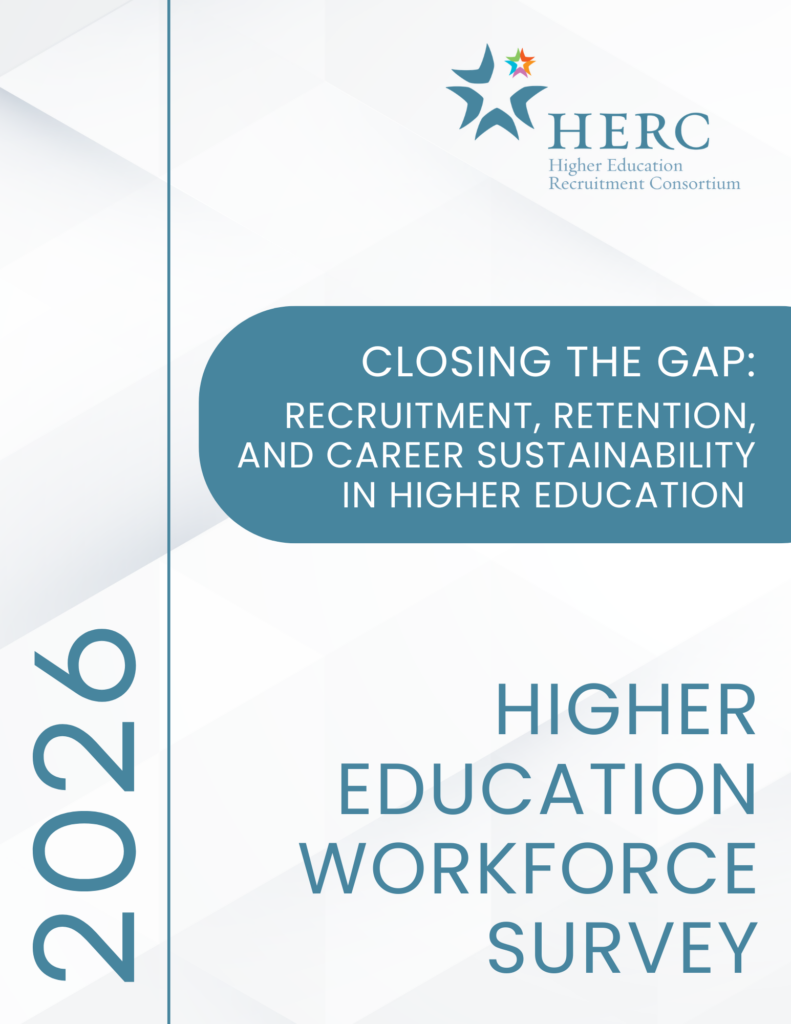
Share Your Voice and Enter For a Chance to Win

April 15, 2026 by Marketing Director

TAKE SURVEY

The higher education workforce is undergoing rapid change, shaped by shifting societal expectations, advancing technology, and ongoing national and global challenges. Institutions are rethinking how they attract, support, and retain talent, and they need direct insight from professionals like you.

This survey is an opportunity to share what matters most to you right now and what you need from employers moving forward. Your perspective will help colleges and universities better align their practices with the realities of today’s workforce.

We compile the results into a comprehensive report with actionable recommendations, shared with our member institutions committed to building more supportive, equitable, and inclusive workplaces across higher education.

If you complete the entire survey and are eligible, you can enter for a chance to win one of eight $50 gift cards (winners will be able to choose a gift card on Giftogram). At the end of the survey, you will have the opportunity to enter your email address for a chance to win.

The survey should take about 10 to complete. It will be live from Monday, April 20, 2026, until 11:59 pm PST on Friday, May 22, 2026. Please note: Survey prizes are only open to U.S. residents over the age of 18.

Your confidentiality is important to us. All data is stored in a password-protected electronic format. To help protect your confidentiality, the surveys will not contain information that will personally identify you. The results of this survey will be used to communicate job seeker trends to HERC member institutions and to develop new job search and career resources. If you have any questions or feedback about the survey, please contact marketing@hercjobs.org.

Terms and Conditions:

NO PURCHASE IS NECESSARY TO ENTER OR WIN. A PURCHASE DOES NOT INCREASE THE CHANCES OF WINNING.

1. Eligibility: The Campaign is only open to legal residents of the United States of America who are 18 years of age or older as of the date of entry, and is void where prohibited by law. Employees of the Higher Education Recruitment Consortium, a project of the Tides Center (HERC Jobs), its affiliates, subsidiaries, advertising and promotion agencies, and suppliers (collectively the “Employees”), and immediate family members and/or those living in the same household of Employees are not eligible to participate in the Campaign. The Campaign is subject to all applicable federal, state, and local laws and regulations. Void where prohibited.

2. Agreement to Rules: By participating, the Contestant (“You”) agree to be fully unconditionally bound by these Rules, and You represent and warrant that You meet the eligibility requirements. In addition, You agree to accept the decisions of the Higher Education Recruitment Consortium, a project of the Tides Center (HERC Jobs) as final and binding as it relates to the content of this Campaign.

3. Campaign Period: Entries will be accepted online starting on Monday, April 20, 2026, and ending on Friday, May 22, 2026. All online entries must be received by Friday, May 22, 2026, at 11:59 PM PST.

4. How to Enter: Enter to win by completing this survey. The entry must fulfill all Campaign requirements, as specified, to be eligible to win a prize. Entries that are incomplete or do not adhere to the rules or specifications may be disqualified at the sole discretion of the Higher Education Recruitment Consortium, a project of the Tides Center (HERC Jobs). Limit one (1) entry per person and per email address. Eight (8) potential prize winners will be chosen in a random drawing from among all eligible entries received. You must provide the information requested. You may not enter more times than indicated by using multiple email addresses, identities, or devices in an attempt to circumvent the rules. If you use fraudulent methods or otherwise attempt to circumvent the rules, your submission may be removed from eligibility at the sole discretion of the Higher Education Recruitment Consortium, a project of the Tides Center (HERC Jobs).

5. Prizes: The eight Winner(s) of the Campaign (the “Winner”) will receive one of eight $50 (USD) gift cards selected through a gift card company. The specifics of the prize shall be solely determined by the Higher Education Recruitment Consortium, a project of the Tides Center (HERC Jobs). No cash or other prize substitution shall be permitted except at the Higher Education Recruitment Consortium, a project of the Tides Center (HERC Jobs)’s discretion. The prize is nontransferable. Any and all prize-related expenses, including without limitation any and all federal, state, and/or local taxes, shall be the sole responsibility of Winner. No substitution of prize or transfer/assignment of prize to others or request for the cash equivalent by Winner is permitted. Acceptance of prize constitutes permission for the Higher Education Recruitment Consortium, a project of the Tides Center (HERC Jobs) to use Winner’s name and entry for purposes of advertising and trade without further compensation, unless prohibited by law.

6. Odds: The odds of winning depend on the number of eligible entries received.

7. Winner Selection and Notification: Winner will be selected by a random drawing under the supervision of the Higher Education Recruitment Consortium, a project of the Tides Center (HERC Jobs). Winner will be notified by email within five (5) days following selection of Winner. The Higher Education Recruitment Consortium, a project of the Tides Center (HERC Jobs) shall have no liability for Winner’s failure to receive notices due to spam, junk e-mail, or other security settings or for Winner’s provision of incorrect or otherwise non-functioning contact information. If Winner cannot be contacted, is ineligible, fails to claim the prize within 7 days from the time award notification was sent, or fails to timely return a completed and executed declaration and release as required, the prize may be forfeited and an alternate Winner selected. Receipt by Winner of the prize offered in this Campaign is conditioned upon compliance with any and all federal, state, and local laws and regulations. ANY VIOLATION OF THESE OFFICIAL RULES BY WINNER (AT THE HIGHER EDUCATION RECRUITMENT CONSORTIUM’S SOLE DISCRETION) WILL RESULT IN WINNER’S DISQUALIFICATION AS WINNER OF THE CAMPAIGN, AND ALL PRIVILEGES AS WINNER WILL BE IMMEDIATELY TERMINATED.

8. Rights Granted by You: You shall indemnify, defend, and hold harmless the Higher Education Recruitment Consortium, a project of the Tides Center (HERC Jobs) from and against any suit, proceeding, claims, liability, loss, damage, costs or expense, which the Higher Education Recruitment Consortium, a project of the Tides Center (HERC Jobs) may incur, suffer, or be required to pay arising out of such infringement or suspected infringement of any third party’s right.

9. Terms & Conditions: The Higher Education Recruitment Consortium, a project of the Tides Center (HERC Jobs) reserves the right, in its sole discretion, to cancel, terminate, modify or suspend the Campaign should virus, bug, non-authorized human intervention, fraud, or other cause beyond the Higher Education Recruitment Consortium’s, a project of the Tides Center (HERC Jobs) control corrupt or affect the administration, security, fairness, or proper conduct of the Campaign. In such case, the Higher Education Recruitment Consortium, a project of the Tides Center (HERC Jobs) may select the Winner from all eligible entries received prior to and/or after (if appropriate) the action taken by the Higher Education Recruitment Consortium, a project of the Tides Center (HERC Jobs). The Higher Education Recruitment Consortium, a project of the Tides Center (HERC Jobs) reserves the right, in its sole discretion, to disqualify any individual who tampers or attempts to tamper with the entry process or the operation of the Campaign or website or violates these Terms & Conditions. The Higher Education Recruitment Consortium, a project of the Tides Center (HERC Jobs) has the right, in its sole discretion, to maintain the integrity of the Campaign, to void votes for any reason, including, but not limited to: multiple entries from the same user from different IP addresses; multiple entries from the same computer in excess of that allowed by Campaign rules; or the use of bots, macros, scripts, or other technical means for entering. Any attempt by an entrant to deliberately damage any website or undermine the legitimate operation of the Campaign may be a violation of criminal and civil laws. Should such attempt be made, the Higher Education Recruitment Consortium, a project of the Tides Center (HERC Jobs) reserves the right to seek damages to the fullest extent permitted by law.

10. Limitation of Liability: By entering, You agree to release and hold harmless the Higher Education Recruitment Consortium, a project of the Tides Center (HERC Jobs) and its subsidiaries, affiliates, advertising and promotion agencies, partners, representatives, agents, successors, assigns, employees, officers, and directors from any liability, illness, injury, death, loss, litigation, claim, or damage that may occur, directly or indirectly, whether caused by negligence or not, from: (i) such entrant’s participation in the Campaign and/or his/her acceptance, possession, use, or misuse of any prize or any portion thereof; (ii) technical failures of any kind, including but not limited to the malfunction of any computer, cable, network, hardware, or software, or other mechanical equipment; (iii) the unavailability or inaccessibility of any transmissions, telephone, or Internet service; (iv) unauthorized human intervention in any part of the entry process or the Promotion; (v) electronic or human error in the administration of the Promotion or the processing of entries.

11. Disputes: THIS Campaign IS GOVERNED BY THE LAWS OF the United States of America AND California, WITHOUT RESPECT TO CONFLICT OF LAW DOCTRINES. As a condition of participating in this Campaign, participant agrees that any and all disputes that cannot be resolved between the parties, and causes of action arising out of or connected with this Campaign, shall be resolved individually, without resort to any form of class action, exclusively before a court located in California having jurisdiction. Further, in any such dispute, under no circumstances shall participant be permitted to obtain awards for, and hereby waives all rights to, punitive, incidental, or consequential damages, including reasonable attorney’s fees, other than participant’s actual out-of-pocket expenses (i.e. costs associated with entering this Campaign). Participant further waives all rights to have damages multiplied or increased.

12. Privacy Policy: Information submitted with an entry is subject to the Privacy Policy stated on the Higher Education Recruitment Consortium, a project of the Tides Center (HERC Jobs) website. To read the Privacy Policy, click here.

13. Winners List: To obtain a copy of the Winners’ names or a copy of these Official Rules, mail your request along with a stamped, self-addressed envelope to: The Higher Education Recruitment Consortium, PO Box 3794, Santa Cruz, CA 95063 USA. Requests must be received no later than June 30, 2026.

14. Sponsor: The Sponsor of the Campaign is the Higher Education Recruitment Consortium, PO Box 3794, Santa Cruz, CA 95063. The Campaign hosted by the Higher Education Recruitment Consortium, a project of the Tides Center (HERC Jobs) is in no way sponsored, endorsed, administered by, or associated with Facebook, Twitter, or LinkedIn.

Filed Under: Job Seeker Survey

Behind the Title: JD Jordan, Information & Technology Services

April 9, 2026 by Marketing Director

Text: HERC Jobs Podcast: Let's Talk Higher Ed Careers

Learn how to start or grow your career in higher education with insights from professionals, career coaches, and HR experts. The newly launched Let’s Talk Higher Ed Careers podcast, produced by HERC Jobs, explores a variety of campus roles beyond teaching, career growth strategies, and tips for navigating the higher ed job market. Whether you’re new to the field or ready to move up, each episode shares real stories and practical steps to help you align your goals, discover opportunities, and succeed in a fulfilling higher ed career. New episodes drop every two weeks on our YouTube Channel.

In this “Behind the Title” episode of Let’s Talk Higher Ed Careers, host Jessica Wise sits down with J.D. Jordan, Desktop Support Manager in Information and Technology Services at the University of Michigan, to explore his journey from the U.S. Air Force to IT leadership in higher ed.

J.D. shares how mentorship, adaptability, and a willingness to start at the ground level helped him grow from an entry-level role to managing multiple teams supporting campus-wide technology. He offers candid insights into the cultural differences between military and higher education workplaces, from communication styles to decision-making, and how veterans can successfully navigate the transition. J.D. also reflects on the deeper value of working in higher education: community, purpose, and the opportunity to shape the next generation.

Watch this “Behind the Title” episode on YouTube and tell us what resonated most in the comments. While you’re there, subscribe to our video podcast series so you never miss a conversation.
Filed Under: Podcasts, Veterans, Videos

How to Spot a Real Higher Ed Job Posting

April 7, 2026 by Marketing Director

You open your inbox and find an email from someone claiming to be a recruiter at a major university or research institution. The subject line is tempting: “Exciting opportunity at [Big University]—apply today!” Before you hit reply, take a moment. Not every job opening that lands in your inbox is legitimate. Here’s how to separate real higher education opportunities from misleading postings.

1. Verify the email address and “Reply-To” fields

Official university recruiters typically email from the institution’s domain (e.g., @harvard.edu, @ucr.edu). Be extremely cautious if the email comes from a personal provider like Gmail or Yahoo, or a generic business tool like AppSheet.

  • Check the “Reply-To” address: Scammers often use an authentic-looking display name but set the “Reply-To” to a look-alike domain (e.g., joinus@universitycareerguide.com instead of @university.edu).
  • Watch for unrelated CCs: If the email CCs an address from a completely different company or a suspicious domain, it’s a major red flag.

2. Cross-check with the university’s HR portal

Do not click on links provided in a suspicious email. Instead, open a new browser window and navigate directly to the institution’s official website. Higher ed institutions post openings on official HR or careers websites. If the position, such as a Vice President or Department Chair, isn’t listed there or on reputable academic job boards like HERC Jobs, HigherEdJobs, or ChronicleVitae, it’s a red flag. Academic institutions almost always list roles on their official HR or careers portals—even when using an external search firm.

3. Examine the posting details

Legitimate academic postings usually include a clear title, department affiliation, and specific responsibilities.

  • Beware of “Exclusive Opportunity” Flattery: Scammers often use vague, high-pressure language claiming the role is a “private and exclusive opportunity” designed “specifically for you” to lower your guard. Academic hiring is rarely secretive or personalized at first contact.
  • Look for Substance: If the description focuses more on “prestige” and “extraordinary chances” than on the actual academic or administrative requirements of the unit, be wary.

4. Look for inconsistencies in academic structure

Scam emails often misuse academic terminology. Examples include:

  • Referring to a “Dean of Marketing Department” at a university that doesn’t have that structure
  • Using corporate language for faculty-track roles
  • Offering “remote adjunct professor” roles with unrealistic pay

Higher ed is structurally specific. Scammers frequently get it wrong.

5. Evaluate the recruiter’s style and pressure tactics

Academic HR professionals and search committees are typically deliberate and follow a strict timeline.

  • The “Spam Folder” Tactic: Be suspicious if a recruiter asks you to “check your spam or junk folder” to find their links. While legitimate institutional emails can occasionally land in spam, recruiters are likely not relying on spam-folder workarounds or sending you untraceable links.
  • Automated Scheduling: While many institutions use scheduling tools after initial contact, receiving an unsolicited interview link before any screening conversation is highly unusual for most academic roles.

6. Never pay to apply

Universities and colleges do not charge applicants to apply, interview, or complete background checks as a condition of employment. Any financial request made as part of the interview process is a scam.

7. Confirm the recruiter’s credentials

Look them up on LinkedIn or the university’s staff directory. Legitimate academic recruiters have a verifiable presence. If the email is signed by a generic “Hiring Team” or “Recruiting” without a specific name or title, proceed with extreme caution.

8. Trust your instincts

Academic hiring processes are typically transparent and structured, not rushed. If you suddenly receive an unsolicited “dream job” offer for a full-time executive role, pause and investigate. If it feels too good to be true, it likely is.

9. Watch for the “Mobile Pivot” (SMS and WhatsApp Scams)

While many academic searches start via email, scammers are increasingly moving to text-based platforms to catch you off guard.

  • The Unsolicited “Dean” Text: You may receive a text from someone claiming to be a Department Chair or Dean asking for a “quick favor” or an “urgent discussion” about a role. Real academic leaders almost never initiate high-level recruitment via a personal SMS to your cell phone.
  • The WhatsApp Interview: Be wary of any “recruiter” who asks to move the conversation to WhatsApp or Telegram for a “screening.” Legitimate higher ed institutions use secure institutional platforms, like Zoom; Microsoft Teams; or Webex, for remote interviews.
  • Urgency as a Weapon: Text scams often use phrases like “I haven’t received a response” or “select a time slot immediately” to trigger a sense of fear. In the deliberate world of academia, legitimate search committees will provide you with a professional window of time to respond, not a high-pressure countdown via text.
  • Hidden Short-Links: On a mobile device, it is harder to inspect a URL before clicking. If a text includes a shortened link (like bit.ly or t.co) for a job description or “interview scheduling,” do not click it. Instead, go to your desktop and find the position on the official university .edu site.

Bottom line: Real higher education job postings follow institutional protocols, use official .edu domains, and never pressure you to click mysterious links in your spam folder or via a random text message. A few minutes of checking can protect your time, energy, and personal information.

Check out more Top Articles on HERC Jobs.

About the Author: Deepthi Welaratna is a strategic designer and founder of Tiny Little Cosmos, a studio that helps individuals and organizations navigate moments of change with clarity and creativity. Deepthi has led workforce and leadership initiatives with universities, nonprofits, and companies, including Parsons ELab at The New School, the University of Toronto, The Knowledge House, Google, and the Center for Global Policy Solutions.

Filed Under: Job Search, Top Articles Tagged With: Deepthi Welaratna

Ask a Recruiter: Cristian Garcia, University of Houston

March 26, 2026 by Marketing Director

Text: HERC Jobs Podcast: Let's Talk Higher Ed Careers

Learn how to start or grow your career in higher education with insights from professionals, career coaches, and HR experts. The newly launched Let’s Talk Higher Ed Careers podcast, produced by HERC Jobs, explores a variety of campus roles beyond teaching, career growth strategies, and tips for navigating the higher ed job market. Whether you’re new to the field or ready to move up, each episode shares real stories and practical steps to help you align your goals, discover opportunities, and succeed in a fulfilling higher ed career. New episodes drop every two weeks on our YouTube Channel.

In this “Ask a Recruiter” episode of Let’s Talk Higher Ed Careers, Jessica Wise welcomes Cristian Garcia, Lead Senior HR Recruiter at the University of Houston, to pull back the curtain on what really happens behind the scenes of a higher ed job search.

Cristian shares what it’s like to recruit for one of the largest public universities in Texas and why higher education offers more career paths than many job seekers realize. From IT professionals to accountants, marketing specialists, and student affairs leaders, the opportunities extend far beyond faculty roles. Cristian also offers candid advice for recent graduates and early-career professionals navigating today’s hiring process, including why patience matters and how authenticity can set you apart.

Watch this “Ask a Recruiter” episode on YouTube and tell us what resonated most in the comments. While you’re there, subscribe to our video podcast series so you never miss a conversation.

Filed Under: Podcasts, Videos

Behind the Title: Yvonne Wojcicki, Campus Life Safety

March 12, 2026 by Marketing Director

Text: HERC Jobs Podcast: Let's Talk Higher Ed Careers

Learn how to start or grow your career in higher education with insights from professionals, career coaches, and HR experts. The newly launched Let’s Talk Higher Ed Careers podcast, produced by HERC Jobs, explores a variety of campus roles beyond teaching, career growth strategies, and tips for navigating the higher ed job market. Whether you’re new to the field or ready to move up, each episode shares real stories and practical steps to help you align your goals, discover opportunities, and succeed in a fulfilling higher ed career. New episodes drop every two weeks on our YouTube Channel.

In this “Behind the Title” episode of Let’s Talk Higher Ed Careers, we dive into the unique world of campus safety with Yvonne Wojcicki, Executive Director of Campus Life Safety and Regulation Compliance at Columbia University Irving Medical Center.

Host Jessica Wise and Yvonne discuss the importance of safety in higher education and Yvonne’s journey from healthcare to academia. Yvonne shares insights into regulatory compliance and emergency management roles and offers tips for job seekers in higher education, including the value of transferable skills and the importance of networking. The conversation also touches on the challenges and rewards of working in a siloed environment and how to break down barriers.

Watch this “Behind the Title” episode on YouTube and tell us what resonated most in the comments. While you’re there, subscribe to our video podcast series so you never miss a conversation.

Filed Under: Podcasts, Videos

Career Growth: Moving Up Without Moving On

March 5, 2026 by Marketing Director

For many professionals, career growth is often framed as a major leap. A new institution, a new employer, or a fresh start elsewhere is usually seen as the primary path forward. While external moves can absolutely be valuable, they are not the only way to grow. Some of the most meaningful and sustainable career development can happen without ever leaving your current institution.

Whether you are motivated by stability, benefits, mission alignment, geographic limits, or health and life circumstances, staying put does not mean standing still. Career growth can take many forms, and institutions often offer more opportunities than we realize once we expand how we define progress.

Redefining What Career Growth Really Means

Career growth is often equated with promotions, new titles, and higher salaries. While those markers matter, they are not the full picture. Growth can also look like gaining new skills, increasing autonomy, expanding influence, or doing work that feels more aligned with your values and strengths.

Institutions, particularly in higher education and mission-driven organizations, tend to value institutional knowledge, collaboration, and adaptability. Employees who understand how systems connect and who can move comfortably across departments often become indispensable. When growth is defined only by upward movement, these forms of development are easy to overlook. Reframing growth as progress toward the kind of work and impact you want to make opens more realistic and accessible options.

Lateral Moves That Build Long-Term Momentum

Lateral moves are one of the most underestimated forms of career growth. Moving into a role at the same level but in a different department or functional area can significantly expand your skill set and professional network.

For example, transitioning from academic affairs to student services, or from operations to compliance or assessment, can deepen your understanding of how the institution functions. These moves build credibility and visibility while positioning you for future leadership roles that require cross-functional knowledge.

Lateral growth is sometimes dismissed as a lack of ambition, but in reality, it is often a strategic investment. Professionals who have worked across units are better prepared for complex roles later and are frequently considered strong internal candidates when higher-level positions open.

Expanding Your Role Without Changing Your Title

Not all growth requires a formal role change. Many professionals expand their responsibilities within their existing position in ways that meaningfully shape their career trajectory.

This can include taking on special projects, leading pilot initiatives, serving on committees, or becoming the point person for a specific process or skill. Over time, this kind of work builds leadership experience and subject-matter expertise, even if your title remains the same.

The key is to be intentional. Rather than saying yes to everything, focus on opportunities that align with where you want to go next. Document this work carefully and translate it into outcomes and skills during performance reviews or when applying for internal roles. Titles matter, but demonstrated impact often matters more.

Skill-Based Growth Opportunities Inside Your Institution

Many institutions offer professional development resources that are underused or overlooked. These might include internal leadership programs, technical training, certifications, memberships, or tuition benefits that allow employees to pursue additional education.

Beyond formal offerings, informal learning can be just as powerful. Job shadowing, cross-training with colleagues, or collaborating closely with another department can help you build skills without changing roles.

Skill-based growth increases internal mobility by making you eligible for a broader range of positions. Skills such as data analysis, assessment, budgeting, compliance, instructional design, project management, and equity-focused work are especially valuable across departments. Developing these competencies can quietly open doors long before a new job posting appears.

Increasing Influence and Visibility Without a Promotion

Influence is a form of career capital that often precedes formal advancement. Increasing your visibility and impact does not require a new title, but it does require consistency and strategic engagement.

Mentorship is a powerful avenue, both for mentees and for mentors. Participating in institution-wide initiatives, representing your department on task forces, or presenting on successful projects can also raise your profile.

Over time, people begin to associate you with reliability, innovation, or problem-solving. This reputation can lead to invitations, opportunities, and internal recommendations that are not advertised publicly. Influence builds slowly, but it compounds in meaningful ways.

Advocating for Growth Where You Are

Growth within an institution rarely happens without some level of advocacy. Waiting for opportunities to appear can lead to stagnation, even in supportive environments.

Productive conversations with supervisors focus on alignment. Framing your growth as beneficial to both you and the institution makes it easier to support your requests. This might include requesting adjusted responsibilities, professional development funding, leadership opportunities, or clarity on future pathways.

These conversations do not need to be confrontational or overly formal. They are most effective when grounded in shared goals and realistic expectations. Even when immediate changes are not possible, these discussions plant seeds for future movement.

Staying Can Be a Strategy, Not a Setback

Choosing to stay at your current institution is not a failure of ambition. In many cases, it is a thoughtful and strategic decision. Growth does not always require starting over, and leaving is not the only path forward.

By broadening how you define career progress and paying closer attention to internal opportunities, you may find your institution offers more room to grow than you expected. With intention, curiosity, and advocacy, staying can be an active career strategy that supports both your professional goals and your long-term well-being.

Check out Top Articles on HERC Jobs.

About the Author: Shelby Harris is a freelance writer and public sociologist. She holds a master’s degree in Sociology from East Carolina University.

Filed Under: Career Advice, Career Planning Tagged With: Shelby Harris

  • 1
  • 2
  • 3
  • …
  • 19
  • Next Page »

Find it Fast

Join HERC
HERConnect (Member Login)
  • Partners
  • About Us
  • Newsroom
  • Contact Us

Regional HERCS

  • Carolinas
  • Greater Chicago Midwest
  • Metro New York & Southern Connecticut
  • Michigan – Ohio – Western Pennsylvania – West Virginia
  • Mid -Atlantic
  • Midwest
  • Mountain West
  • New England
  • New Jersey – Eastern Pennsylvania – Delaware
  • Northern California
  • Northwest
  • Southeast
  • South Midwest
  • Southern California
  • Upstate New York
© 2000 – 2026 The Higher Education Recruitment Consortium is a project of the Tides Center, a 501(c)3 non-profit organization.
Tides’ State Nonprofit Disclosures
Sitemap | Terms | Privacy Policy
Powered by WSI Digital
Cookie settingsAccept Cookies
We use cookies so that we can remember you and understand how you use our site. If you do not agree with our use of cookies, please change the current settings found in our Cookie Policy . Otherwise, you agree to the use of the cookies as they are currently set....
Privacy & Cookies Policy

Privacy Overview

This website uses cookies to improve your experience while you navigate through the website. Out of these cookies, the cookies that are categorized as necessary are stored on your browser as they are essential for the working of basic functionalities of the website. We also use third-party cookies that help us analyze and understand how you use this website. These cookies will be stored in your browser only with your consent. You also have the option to opt-out of these cookies. But opting out of some of these cookies may have an effect on your browsing experience.
Necessary
Always Enabled
Necessary cookies are absolutely essential for the website to function properly. This category only includes cookies that ensures basic functionalities and security features of the website. These cookies do not store any personal information.
Non-necessary
Any cookies that may not be particularly necessary for the website to function and is used specifically to collect user personal data via analytics, ads, other embedded contents are termed as non-necessary cookies. It is mandatory to procure user consent prior to running these cookies on your website.
SAVE & ACCEPT